Free Shipping Within USA | 1-year Warranty
How Downtime Directly Reduces Equipment ROI
Heavy machinery is a huge capital investment for your construction business. When you buy or finance a new wheel loader, bulldozer, or excavator, you expect it to work nonstop to make money. You figure out your bids, plan your crews, and guess how much money you’ll make based on the idea that your fleet will work well.
But the truth is that the job site is often very different from what they say. Mechanical failures that weren’t planned can stop progress in its tracks, turning an asset that makes money into a huge financial burden. A broken machine has effects that go far beyond the cost of a new part. Every minute a machine isn’t in use, it actively takes money out of your working capital.
We understand that your success depends entirely on operational reliability. In this guide, we will break down exactly how equipment downtime directly reduces your Return on Investment (ROI). You will learn the hidden financial losses caused by idle crews, compounded project delays, and emergency repair expenses, giving you the insights needed to protect your profitability.
Understanding the True Equipment Downtime Cost
When evaluating the impact of a broken machine, many contractors focus solely on the repair invoice. While parts and mechanic labor are expensive, they only represent the tip of the iceberg. To calculate your actual equipment downtime cost, you must factor in the operational chaos that follows a mechanical failure.
Wasted Labor and Idle Crews
Construction is a highly synchronized process. A single piece of heavy equipment often dictates the workflow for an entire crew. If your primary trenching excavator blows a hydraulic hose, the operator cannot work. But the financial bleeding does not stop there.
The pipe-layers waiting in the trench, the dump truck drivers scheduled to haul away the dirt, and the site supervisors managing the phase all come to a standstill. You continue to pay full hourly wages, benefits, and insurance for a crew that is currently producing absolutely zero revenue. Paying skilled laborers to sit idle is one of the fastest ways to destroy a project’s profit margin.
Direct Emergency Repair Expenses
Planned maintenance is highly predictable and cost-effective. Unplanned downtime is exactly the opposite. When a machine breaks down mid-shift, you do not have the luxury of shopping around for the best price on parts or waiting for standard shipping.
You are forced to pay premium rates for emergency mobile mechanics to dispatch to your job site immediately. If the required part is out of stock locally, you absorb the massive cost of emergency overnight freight. These reactive, desperate repair scenarios inflate your maintenance budget and severely damage the overall ROI of that specific machine.
The Ripple Effect of Project Delays
A construction schedule operates like a carefully arranged set of dominoes. When one task falls behind, it knocks over everything scheduled behind it. Equipment downtime creates severe bottlenecks that threaten your entire project timeline and your professional reputation.
Missed Deadlines and Financial Penalties
Commercial and municipal contracts frequently include strict completion deadlines. If your earthmoving phase stalls because of unreliable machinery, you risk delaying the concrete crews, the framers, and the electricians.
Failing to meet your contractual milestones often triggers liquidated damages or severe financial penalties. Losing thousands of dollars a day in late fees because a loader refused to start will completely erase the profit you expected to make on the job. Your clients expect you to deliver on time, and they rarely accept equipment failure as a valid excuse for missing deadlines.
Expensive Emergency Rentals
To keep the project moving and avoid late penalties, you must replace the broken machine immediately. This means securing a last-minute rental from a local equipment yard.
Renting a replacement machine forces you to pay top-dollar daily or weekly rates. You also have to pay commercial transport fees to get the rental machine delivered to your site. All the while, you are still making your monthly finance and insurance payments on the broken machine sitting in the dirt. Paying for two machines while only utilizing one drastically lowers the expected ROI of your fleet.
How Downtime Destroys Your Expected ROI
ROI is a simple equation: the net profit generated by the machine divided by the total cost of owning and operating it. Downtime aggressively attacks both sides of this equation simultaneously.
Depreciation vs. Utilization
Heavy equipment depreciates every single day, regardless of whether the engine is running. To outpace this depreciation, the machine must maintain a high utilization rate. It needs to work consistently to pay for its own declining value.
When a machine sits broken for two weeks, it still depreciates, but it generates zero revenue to offset that loss in value. You lose a critical window of productive time that you can never get back. Over a five-year lifecycle, chronic downtime reduces the machine’s total lifetime productive hours, guaranteeing a highly disappointing return on your initial capital investment.
Lost Opportunity Costs
A reliable fleet allows you to bid on new projects with absolute confidence. When your equipment functions perfectly, you finish jobs ahead of schedule and rapidly mobilize your crew to the next paying contract.
Conversely, an unreliable fleet traps your business. If your equipment constantly breaks down, your projects drag on for weeks longer than estimated. Because your machinery is tied up on a delayed job site, you cannot bid on or accept new, lucrative contracts. This lost opportunity cost stunts your company’s growth and limits your total annual revenue potential.
Strategies to Protect Your Fleet’s Profitability
You cannot completely eliminate mechanical failures, but you can absolutely minimize their frequency and severity. Protecting your equipment ROI requires a shift from reactive repairs to proactive fleet management.
Implement Strict Preventive Maintenance
The most effective way to combat equipment downtime cost is to prevent the breakdown from happening in the first place. You must commit to a rigorous preventive maintenance schedule based strictly on the manufacturer’s recommendations.
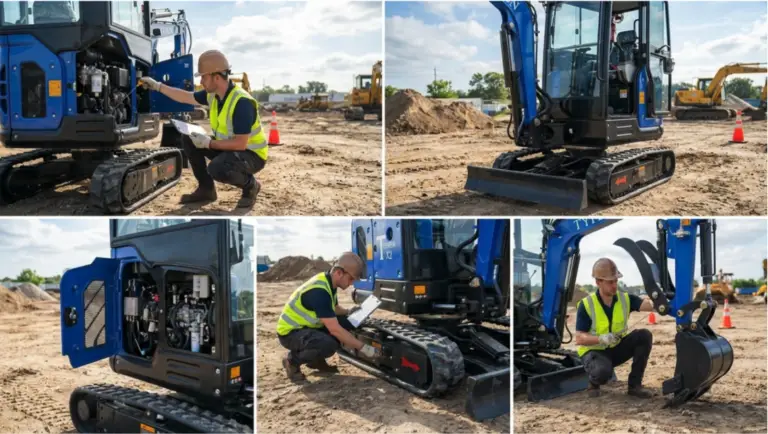
Change the engine oil, replace hydraulic filters, and grease pivot points religiously. Train your operators to perform comprehensive daily walk-around inspections before they ever turn the key. Catching a frayed hose or a minor fluid leak during a morning inspection takes twenty minutes to fix. If you ignore it, that same hose will blow under pressure, shutting down your site for two days.
Utilize Telematics and Condition Monitoring
Modern construction equipment features advanced telematics systems that provide real-time data on the health of your machinery. We strongly recommend leveraging this technology to monitor engine temperatures, fluid pressures, and diagnostic fault codes from your office or mobile device.
Telematics allow you to spot warning signs long before the operator notices a drop in performance. By addressing these minor anomalies early, you schedule the repair during off-hours or weekends, ensuring the machine is ready to work when the Monday morning shift begins.
Conclusion
Maximizing the return on your heavy equipment investment demands total operational consistency. You cannot afford to let sudden mechanical failures dictate your schedule or drain your bank account. The true equipment downtime cost extends far beyond parts and labor; it encompasses idle crews, shattered timelines, emergency rentals, and damaged client relationships.
By recognizing how downtime directly reduces your ROI, you can take proactive steps to defend your working capital. Prioritize strict daily maintenance, utilize telematics to monitor machine health, and partner with reliable dealers who stock the parts you need locally. When you commit to keeping your fleet in peak operating condition, you ensure your machinery remains a powerful, profitable asset that consistently drives your business forward.