Free Shipping Within USA | 1-year Warranty
Skid Steer for Loading, Grading, Digging, and Material Handling
Skid Steer for Loading, Grading, Digging, and Material Handling
Skid steers can handle several stages of a construction project when space, equipment, and time are limited. A single machine may load debris, excavate soil, backfill foundations, grade aggregate, move pallets, and clear scrap by changing attachments and adjusting the operating approach. Productivity depends on using the machine in a way that suits the material, load, surface, and task rather than relying on one setup for every job.
Buckets support common work such as loading, digging, backfilling, grading, and leveling, while toothed buckets can improve penetration in harder ground. Pallet forks provide a different material-handling function, and grapples can help move irregular debris that would be difficult to manage with a standard bucket. Load capacity, attachment compatibility, hydraulic requirements, and operating technique should all be considered before switching between tasks.
Good results also depend on adjusting the operating method to the work being performed. Smaller loads, controlled movements, thin grading layers, and frequent grade checks can improve surface preparation, while appropriate attachment selection can make digging and material handling more efficient. Matching the skid steer and attachment to each task helps improve productivity, protect the machine, and get greater value from a versatile compact machine.
Skid Steer for Loading Work
Loading is one of the most common skid steer applications. With a bucket attachment, the machine can scoop, carry, and place loose materials such as soil, gravel, sand, and debris. A typical loading cycle involves approaching the pile squarely, filling the bucket with controlled movements, backing away with the load carried low, traveling to the dump point, and raising and tilting the bucket when positioned correctly. Smooth, consistent movements can help improve productivity while reducing unnecessary machine strain.
Loading trucks and containers requires additional attention to positioning, visibility, and clearance. The operator should approach the loading area carefully, raise the bucket only when necessary, and place material in a controlled manner to distribute the load evenly. The operator should also consider the truck’s side-wall height and maintain a safe distance from the cab and nearby personnel. Everyone working around the loading area should remain in designated safe positions and follow the site’s operating procedures.
Material weight, machine capacity, and jobsite layout also affect loading efficiency. Dense materials such as wet soil, crushed stone, and broken concrete can place more demand on the machine than lighter materials, so operators should stay within the skid steer’s rated operating capacity and follow the manufacturer’s recommendations. Keeping stockpiles accessible, maintaining clear travel paths, and minimizing unnecessary travel distance can help create smoother loading cycles and improve overall productivity.
Key takeaway: A bucket lets a skid steer scoop, carry, and place soil, gravel, sand, and debris, and steady, well-planned loading cycles move material efficiently while keeping every load within rated capacity.
Grading and Surface Preparation
Grading and surface preparation create a suitable foundation for work such as slabs, walkways, parking areas, and landscaping. A skid steer equipped with a bucket or grading attachment can help spread gravel, base material, soil, and other materials while shaping the ground to the required contours. Operators can use controlled movements to smooth uneven areas, fill low spots, backfill excavations, and prepare surfaces for the next stage of construction.
Good grading depends on smooth attachment control and consistent passes across the work area. Material should be distributed evenly rather than placed in large piles, and the bucket or grading attachment should be operated with controlled movements to avoid creating new high and low spots. Backfilling around foundations, utilities, and other structures also requires care to avoid placing excessive pressure on newly completed work. Operators should follow the project’s specifications for materials, compaction, and safe working distances.
Drainage should also be considered throughout the grading process. Finished surfaces need to direct water toward appropriate drainage areas and away from buildings or other structures. Checking the grade during the work can help identify problems before the surface is completed. Careful planning, consistent passes, and regular grade checks can reduce rework and help produce a more uniform finished surface.
For finish grading over larger areas, a dedicated grading attachment, such as a box blade, land plane, or grader, can produce more consistent results than a bucket alone.
Key takeaway: A skid steer supports grading, leveling, spreading, and backfilling with a bucket or suitable grading attachment, and controlled, gradual movements with frequent grade checks produce surfaces ready for the next stage of construction.
Attachment Versatility
Attachments allow a skid steer to handle different tasks without requiring a separate machine for every job. Buckets, forks, grapples, augers, grading tools, trenchers, breakers, and sweepers can expand the machine’s capabilities across construction and site work. Proper compatibility and attachment conditions are essential for reliable operation.
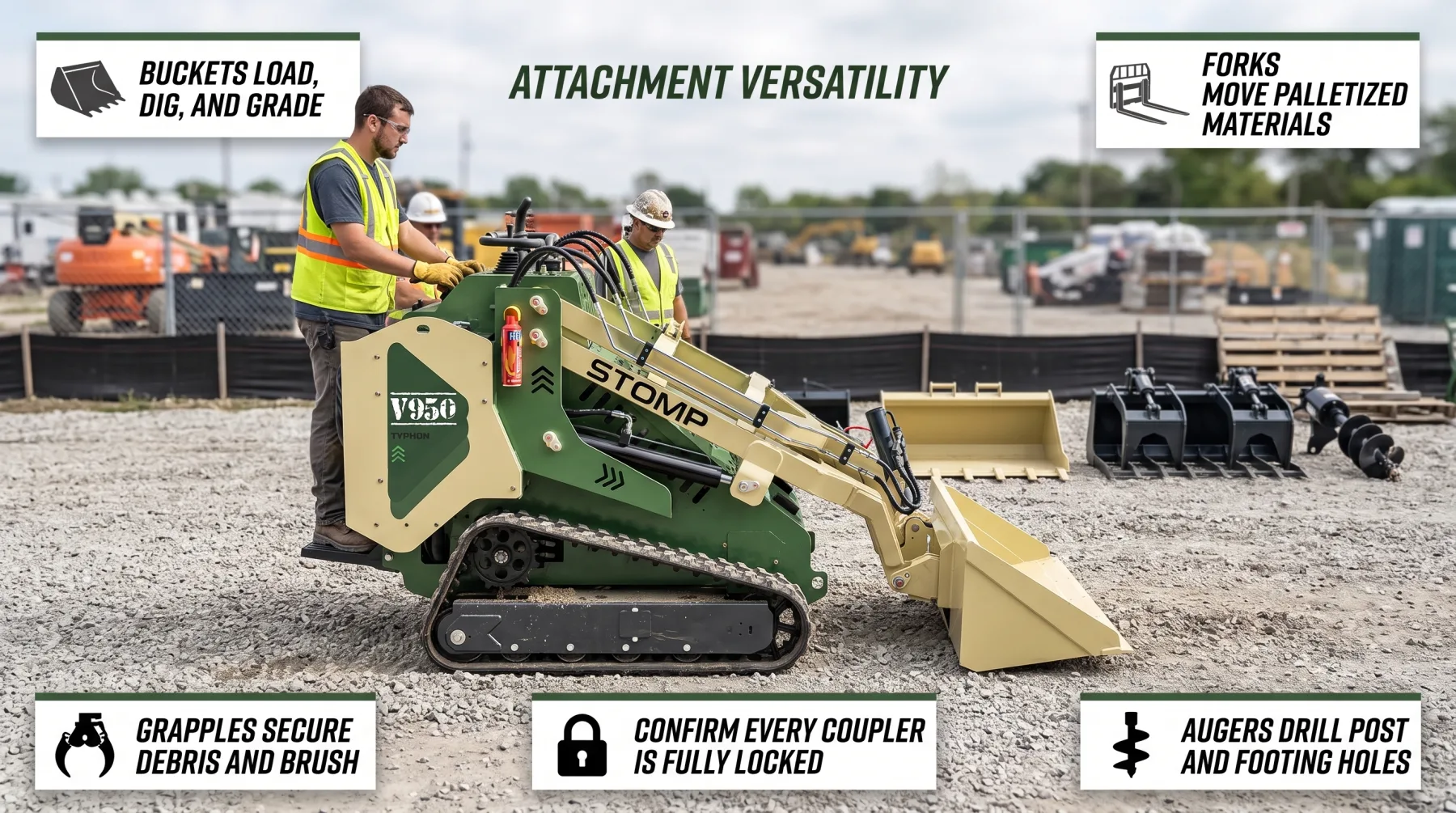
- Material Handling Attachments: Buckets, pallet forks, and grapples support loading, carrying, lifting, and moving different materials.
- Specialized Attachments: Augers, trenchers, breakers, and sweepers allow the skid steer to perform drilling, excavation, demolition, and cleanup tasks.
- Hydraulic Compatibility: Match attachment flow and pressure requirements with the machine’s auxiliary hydraulic system for proper performance.
- Mounting Compatibility: Confirm the attachment matches the machine’s coupler and rated operating capacity before use.
- Attachment Condition: Inspect welds, tines, teeth, cutting edges, and locking components for wear or damage before operation.
Key takeaway: Quick attachment changes let a skid steer switch between buckets, forks, grapples, augers, and other compatible tools, so one machine can handle many tasks when every connection is secure and compatible.
Digging and Excavation Tasks
Skid steers can handle a variety of digging and excavation tasks, particularly shallow excavation and work in areas where larger equipment may have limited access. They can remove topsoil, prepare work areas, dig pads and footing areas, backfill excavations, and move excavated material around the jobsite. The attachment used can affect the type of digging the machine can perform. Toothed buckets can help with harder or compacted soils, while smooth-edge buckets are useful when a cleaner surface is needed. Backhoe attachments, trenchers, and augers can expand the machine’s capabilities for deeper digging, utility trenches, and post or footing holes.
Digging technique also affects machine performance and excavation quality. Operators should make controlled cuts and avoid forcing the bucket into material that exceeds the machine’s capabilities. Working through the soil in manageable layers can reduce unnecessary strain and provide better control over the excavation. Operators should also monitor digging depth and surrounding conditions throughout the work and follow safe operating practices when working near structures, utilities, or excavation edges.
Safety comes first on every dig. Contact your local utility locating service before any excavation and wait for lines to be marked. Hand-expose marked utilities where required. Keep the machine back from excavation edges, since ground near a fresh cut can give way under the weight of a loaded machine. Place spoil well back from the edge, and follow applicable trench protection requirements as depth increases. Never allow workers into an excavation without proper protection.
Key takeaway: Buckets and specialized excavation attachments let a skid steer remove soil, prepare shallow work areas, and backfill excavations, as long as utilities are located and the machine stays safely back from excavation edges.
Material Handling Applications
Construction sites often require more than moving loose soil. Skid steers can handle pallets, pipe, brush, scrap, demolition debris, and other materials when equipped with the appropriate attachment. Buckets are useful for loose materials, pallet forks can move packaged or palletized supplies, and grapples can secure irregular loads that may be difficult to contain with a bucket. Other specialized attachments can also be used for specific materials and applications, depending on the machine and job requirements.
Safe material handling depends on choosing the right attachment and controlling the load throughout the operation. When using pallet forks, position the forks correctly, center the load, and keep it low while traveling. Grapples should hold irregular materials securely, with attention to shifting or extending pieces. Operators should consider how the attachment and load affect machine stability and lifting capacity, maintain clear travel paths, and never carry suspended or unsecured loads over people, vehicles, or the operator’s cab.
Load weight remains the deciding factor across every attachment. A pallet of block or a grapple full of wet logs can weigh much more than it looks. Estimate the weight of each load, include the attachment’s weight, and compare the total with the rated operating capacity. A light rear end, slow lifting, or heavy bouncing is a clear signal to reduce the load.
Key takeaway: Buckets handle loose material, pallet forks move palletized loads, and grapples manage irregular materials and debris, allowing one skid steer to perform several handling tasks within its rated capacity.
Matching Machine Operation to the Task
A skid steer’s versatility is most useful when the machine is properly matched to the work. Performance can be affected by the attachment, material weight, ground conditions, travel distance, and machine configuration. Dense or wet materials can reduce the practical load size, while soft ground, slopes, uneven surfaces, and tight work areas can affect traction, stability, and maneuverability. Choosing the right attachment and machine setup for the application helps the operator work more efficiently.
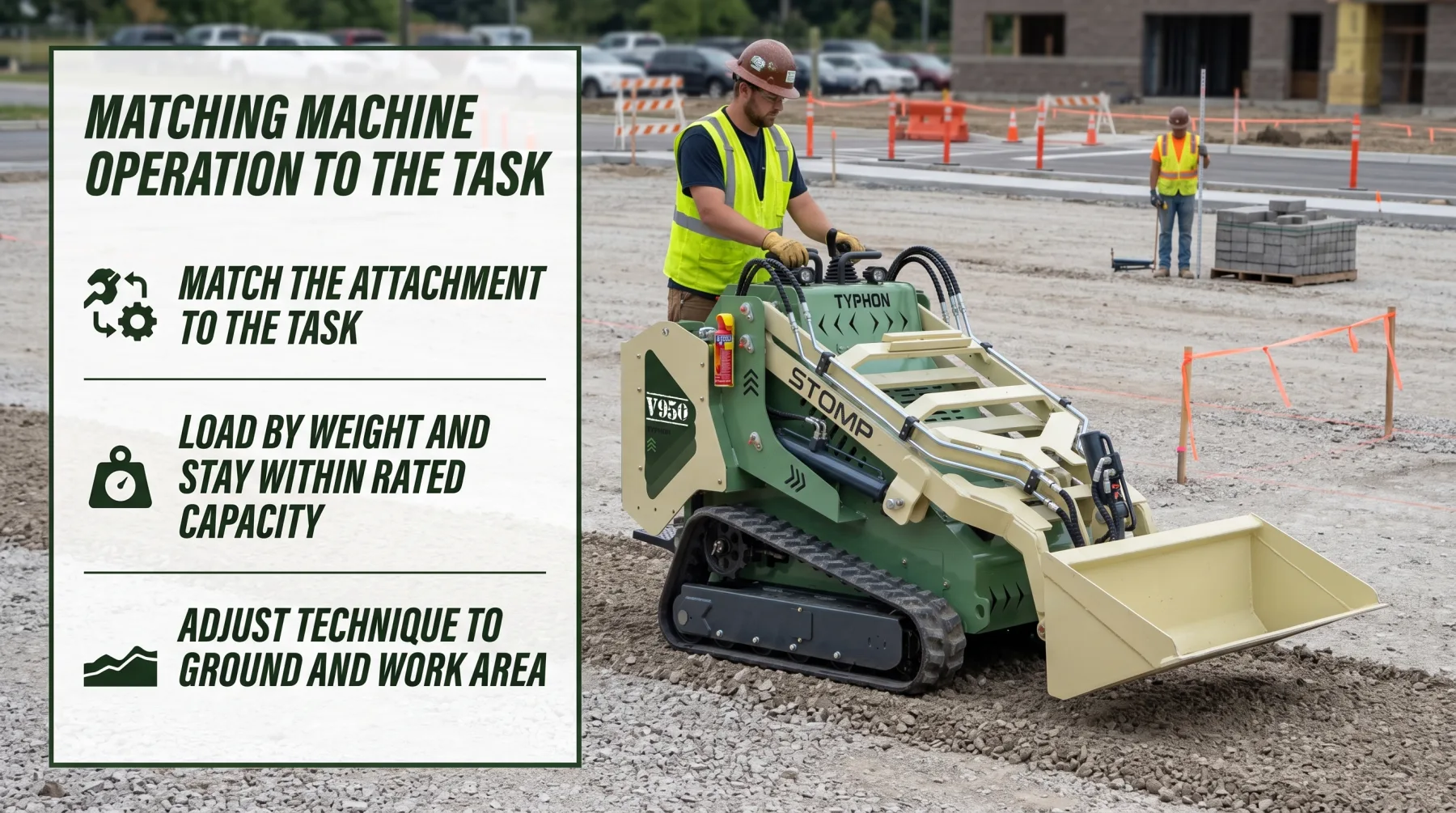
Operating technique should also change depending on the task. Loading benefits from smooth and consistent cycles, while grading requires controlled attachment movements and digging may require more gradual cuts in difficult ground. Pallet handling calls for careful load positioning and controlled movement. When the machine provides adjustable speed or control settings, operators can select settings that provide better control for the work being performed and confirm the control configuration before operation.
Stability and safe load handling remain important across all skid steer applications. Keep loads low during travel and avoid sudden turns or movements when carrying a raised or heavy attachment. Slopes, soft ground, and uneven terrain require additional caution because they can affect machine stability. Operators should follow the manufacturer’s operating instructions, rated capacity, and site-specific safety requirements for the machine and attachment being used.
Keep the work area safe. Fasten the seat belt and lower the seat bar before operating, and never bypass safety interlocks. Keep workers on foot clear of travel and working areas, use a spotter where visibility is limited, and look in the direction of travel before every move.
Key takeaway: Matching the attachment, load, ground conditions, and technique to each task is what turns a skid steer’s versatility into safe, reliable, and productive work.
Conclusion
Skid steers provide a wide range of construction capability from one compact machine, supporting loading, grading, digging, backfilling, and material handling when matched with the right attachments and operating technique. Buckets can load trucks, move stockpiles, and spread material, while toothed buckets and excavation attachments support digging and shallow excavation. Forks and grapples can handle pallets, debris, and irregular materials, with quick couplers allowing efficient attachment changes between tasks. Before operation, operators should check engine oil, coolant, hydraulic fluid, tires or tracks, loader arms, pivot points, cylinders, and hydraulic hoses, then lubricate components according to the manufacturer’s schedule. The selected attachment should be compatible with the machine, fully locked at the coupler, and suited to the material and rated operating capacity. Loads should be centered and carried low, while grading should use controlled inputs and frequent grade checks, and digging should use suitable buckets, shallow cuts, and safe clearance from excavation edges. Operators should also locate underground utilities before digging, assess slopes, soft ground, obstacles, and travel routes, and keep workers clear of loading and working areas. Checking seat belts, seat bar interlocks, horn, lights, backup alarm, windows, and mirrors before work further supports safe and productive skid steer operation across different construction tasks.
Frequently Asked Questions
What can a skid steer be used for?
Common applications include loading, grading, digging, backfilling, material handling, site preparation, and attachment-based construction work. Its compact dimensions and maneuverability make it useful on tight jobsites where larger equipment may have limited access. Different attachments can also allow the same machine to handle tasks such as drilling, trenching, demolition, cleanup, and landscaping.
Can a skid steer perform grading work?
Yes. A bucket, grading attachment, or other suitable tool can level, spread, and prepare construction surfaces. Smooth control inputs help maintain consistent movement, while the float function can allow the attachment to follow the ground surface where appropriate. Frequent grade checks help the operator maintain the required elevation and produce more accurate results.
Which attachments are useful for material handling?
Buckets are commonly used for loose materials such as soil, gravel, sand, and debris. Pallet forks are suited to moving palletized loads, while grapples can handle irregular materials, branches, and construction debris. Other compatible attachments can support specialized handling tasks, but each attachment should match the skid steer’s rated capacity and hydraulic requirements.
Why are skid steer attachments important?
Attachments expand the machine’s capabilities and allow one skid steer to perform different tasks across a construction site. Switching between buckets, forks, grapples, augers, trenchers, and other compatible tools can reduce the need for multiple specialized machines. Proper attachment selection also helps match the machine to the material, working conditions, and specific task.
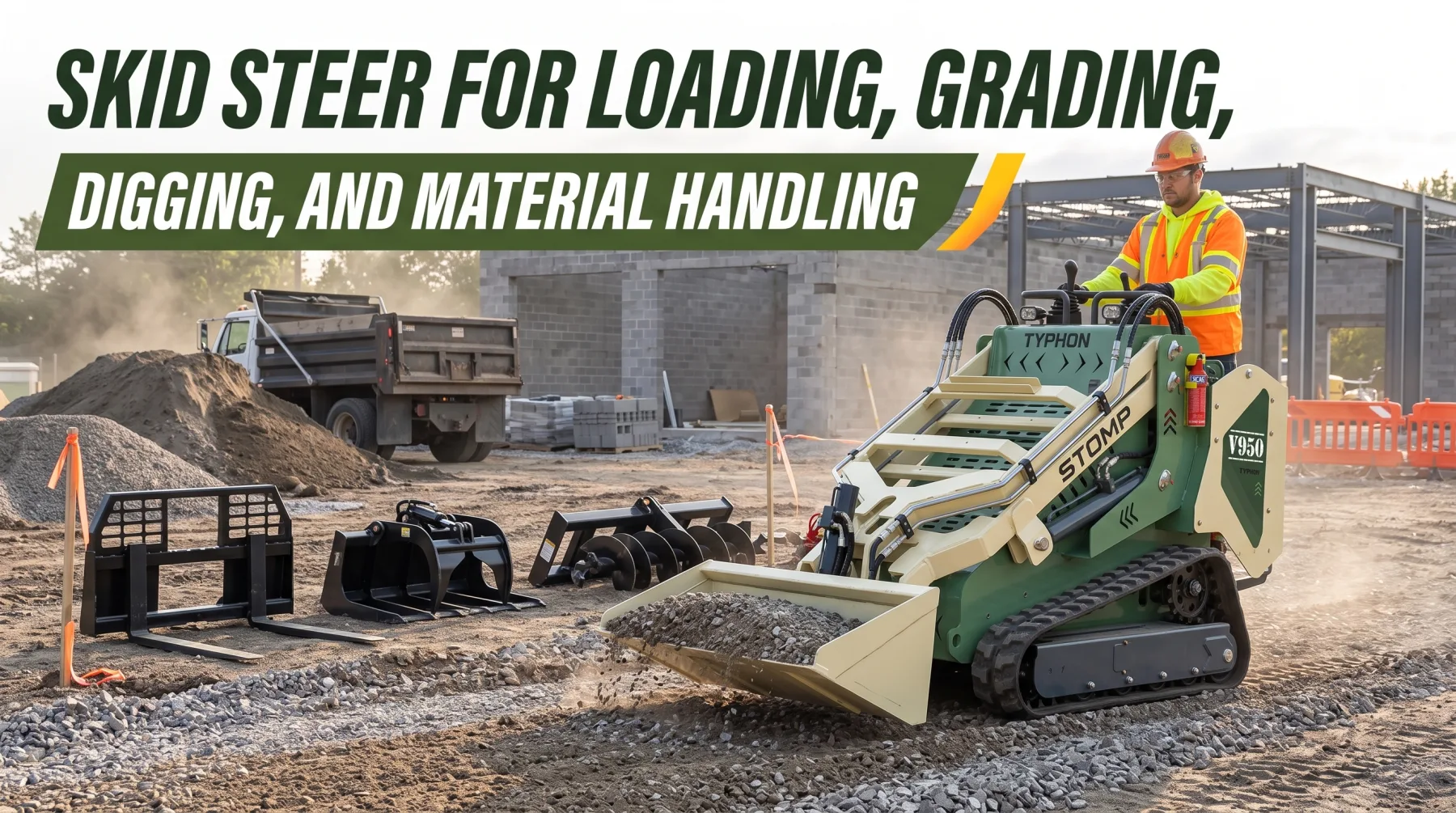
[1. Main Poster (16:9) — “Skid Steer for Loading, Grading, Digging, and Material Handling”
“Photorealistic photography style, not illustrated. An operator in high-visibility gear and safety glasses standing beside an active small commercial construction site for a new single-bay auto service shop, with a freshly graded crushed stone parking base marked with grade stakes, a dump truck parked beside a soil stockpile, pallets of block staged on firm ground, a shallow excavated pad for a dumpster enclosure, and a neat row of skid steer attachments resting on level ground, including pallet forks, a grapple, a toothed bucket, and an auger. Natural daylight, late-afternoon sun, realistic shadows, light dust in the air, real construction setting with barriers and other equipment visible in the background. Position a TYPHON skid steer (bold-branded rear engine cover, dark gray chassis, heavy-duty tires, loader arms with bold vertical ‘TYPHON’ lettering, general-purpose bucket on a quick-attach plate, enclosed operator cab with safety bar) in the lower-right portion of the frame, raising a level bucket of soil smoothly toward the dump truck bed at a right angle, matched appropriately in scale to the site, an operator visible in the cab with seat belt fastened, 16:9 aspect ratio, product occupying roughly 40% of the frame.
Add clean, bold, heavy condensed sans-serif block typography, italicized (slanted upright caps, not distressed, not grunge, crisp solid fills), sized larger to occupy roughly 60% of the frame’s visual weight: top line in bold dark-green/olive italic caps reading ‘SKID STEER FOR LOADING, GRADING,’, filled solid-color italic block bar containing white bold text reading ‘DIGGING, AND MATERIAL HANDLING’, small diagonal yellow-to-orange accent swoosh graphic beside the text. Clean modern industrial-brand aesthetic, sharp crisp block-color layout, text and machine balanced without overlapping.”]
[2. Small Detail — 5-Corner Layout — “Attachment Versatility”
“Photorealistic image, not illustrated, 16:9 aspect ratio. Real job-site background with a firm gravel staging area and a neat row of compatible attachments resting on level ground, including a general-purpose bucket, a toothed bucket, pallet forks, a grapple, and an auger, softly blurred, natural daylight. Center of the frame: a TYPHON skid steer centered with bold-branded rear engine cover, dark gray chassis, heavy-duty tires, loader arms with bold vertical ‘TYPHON’ lettering, and enclosed cab, parked on firm, level ground with a grapple attachment freshly locked onto the quick-attach plate, both locking wedges clearly visible through the mounting slots, auxiliary hydraulic hoses connected cleanly at the front couplers and routed away from pinch points, an operator in gloves and safety glasses confirming the connection with the engine off, conveying fast, secure attachment changes for varied construction tasks.
Around the composition, place 5 small icon-and-text tags spaced evenly around the frame (four corners plus one bottom-center), clean italic bold condensed sans-serif labels matching the main poster’s font, thin dark-green top border on each tag: top-left tag with a bucket icon above ‘BUCKETS LOAD, DIG, AND GRADE’; top-right tag with a pallet-fork icon above ‘FORKS MOVE PALLETIZED MATERIALS’; bottom-left tag with a grapple icon above ‘GRAPPLES SECURE DEBRIS AND BRUSH’; bottom-right tag with an auger icon above ‘AUGERS DRILL POST AND FOOTING HOLES’; bottom-center tag with a lock icon above ‘CONFIRM EVERY COUPLER IS FULLY LOCKED’.
Small bold heading above the composition, same italic font as the main poster, dark-green reading ‘ATTACHMENT VERSATILITY’. Clean, crisp, high-contrast premium construction-brand aesthetic, machine and attachment context as the grounded visual focus, five tags as supporting detail.”]
[3. Small Detail — List Style — “Matching Machine Operation to the Task”
“Photorealistic image, not illustrated, 16:9 aspect ratio. Real construction background with a crushed stone parking base being finished, grade stakes and a string line set across the surface, a crew member at a safe distance checking elevation with a grade rod, a pallet of block staged nearby, and marked travel lanes separating pedestrian walkways, softly blurred, natural daylight. A TYPHON skid steer positioned prominently in frame with bold-branded rear engine cover, dark gray chassis, heavy-duty tires, loader arms with bold vertical ‘TYPHON’ lettering, and enclosed cab, back-dragging a partial bucket of crushed stone with the bucket in float to create a smooth, even surface, cutting edge level and close to the ground, an operator in the cab making small, precise control inputs with seat belt fastened, conveying careful, task-matched operation.
Add a clean vertical list of 3 items in italic bold condensed sans-serif matching the main poster’s font: ‘MATCH THE ATTACHMENT TO THE TASK’ with a small attachment-swap icon; ‘LOAD BY WEIGHT AND STAY WITHIN RATED CAPACITY’ with a small weight-scale icon; ‘ADJUST TECHNIQUE TO GROUND AND WORK AREA’ with a small terrain icon. Thin dark-green divider lines between items.
Small bold heading above, same italic font as the main poster, dark-green reading ‘MATCHING MACHINE OPERATION TO THE TASK’. Clean, crisp, high-contrast premium construction-brand aesthetic, machine and grading-operation context as the grounded visual focus, text sized to balance clearly against the product without overwhelming the frame.”]