Free Shipping Within USA | 1-year Warranty


Typhon Stomp Skid Steer – Power, Precision, and Performance Redefined
Introduction: The Rise of the Typhon Stomp Skid Steer
In the heavy equipment domain, the impact and influence of Typhon are immensely profound. They are regarded as perfectionists who pursue and obtain unrelentingly their goal of absolute perfection.
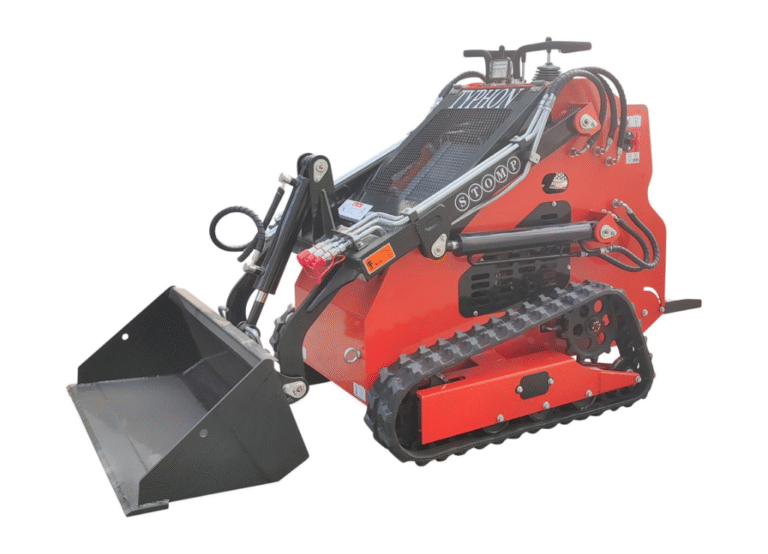
Therefore, with their newest product, the Typhon Stomp Skid Steer, the company has once again changed the compact performance efficiency concept entirely. Stomp represents the combined might of a large loader in a smaller and more agile, quicker, and absolutely controllable body.
It is not only a riot of the power of one but the integration of the advanced technologies of the firm such as Typhon’s engineering wizardry, materials, Cyclone Intelligence AI, and modular attachment technology are what make up the Typhon Stomp—the most potent compact unstoppable force. While other machines are challenging the power-maneuverability balance, the Typhon Stomp excels as if a storm has learned how to dance.
On the one hand, the Stomp has been designed for heavy industrial use, on the other farm activities do no harm to it. Thus, it has become popular among the workers at construction sites, piece works, minerals extractions, salvage, and defense units.
Deployment through the mud, gravel, or snow is safe and sound in the hands of Stomp thanks to the capability of the brand. Carving trenches, taking the load, removing the garbage, or leveling the surface, you will meet the Typhon Stomp—the perfect combination of precision, intelligence, and power.
The Stomp though, is not just an advanced and capable industrial machine, it is Stomp’s spirit, the raw and clever energy that energizes every movement, which is the main differentiating factor.
According to Typhon engineers, it is “controlled chaos”—a device that produces the most minute and exact movements out of the tremendous power it holds. Additionally, similar to its mythological equivalent, Stomp is not merely designed to change the earth but to command it.
The intelligence implemented is the first thing one notices after the ignition. The hydraulic system responds to the slightest command, the turning of the wheel is neat and swift, and the arm moves up and down—you can hardly believe how simple this is. The ordinary skid steer it is not, it is a Typhon after which only one thing can be expected: the extraordinary one.
The Typhon Legacy: A Machine Born from Myth and Innovation
First, to comprehend what is so special about the Typhon Stomp Skid Steer, you need to start from the story of the name. In Greek mythology, Typhon was the god of storms—a giant made of pure energy, chaos, and creation. He had the might to fight the gods themselves and therefore was the personification of nature’s most terrible force.
This very philosophy is what is still propelling Typhon Equipment. The company’s credo, which basically boils down to one single idea, powers every single product: brute force should always be controlled by cleverness.
Typhon’s engineers were not satisfied with making a simply small loader when they thought of the Stomp project. The portable powerhouse that, on the one hand, would be able to yield the output of a normal industrial machine and, on the other, keep the great dexterity and maneuverability of a compact skid steer would be their result only.
The technology turned out to be more of a living organism than a tool of metal—extremely responsive, perfectly balanced, and, if forced, aggressively powerful.
A Lineage Forged in Steel and Storms
The story of Typhon is the company which has survived, with design changes, through the hard times always. Typhon’s heavy construction equipment line has been the result of the innovation period in past years, while the design of the products has always been about overengineering to ensure the product’s longevity and robustness.
While competitors choose the best cost or weight strategies by cutting corners, Typhon chooses to increase the product’s durability even more. The Stomp is the latest product of that philosophy, a compact loader that underwent the same rigorous Trial of the Storm testing process as its bigger brothers.
In the development phase, the first models of the Stomp were tried out in volcanic mines, icy plateaus, and desert construction sites. These devices went through very harsh endurance cycles that were meant to simulate more than 10,000 hours of continuous operation under heavy load.
It was only after going through this mechanical gauntlet that the Typhon engineers approved the final design—a proof of their conviction that durability is not confirmed by time, but by suffering.
A New Standard in Compact Machinery
The Stomp skid steer by the Typhon Stomp has expanded the possibilities of small loaders. While the rest of the market talk about horsepower and attachmets,
Typhon talks about intelligence. The Cyclone Intelligence Platform controls every movement of the Stomp and it is always reading the ground it is working on, hydraulic pressure, and operator movement to ensure maximum stability and efficiency.
So, what is the outcome? A machine that is never overworked, never under performes—just changes its settings. In fact, it is like the storm itself: adaptive, precise, and inexorable.
This is the heritage of Typhon—machines that not only deliver, but also survive. Machines that combine the power of myth with the innovation of the future. And the Typhon Stomp is there to show that even the tiniest machines, when given the soul of a storm, can be as powerful as a god.
Hydraulic System: Precision in Motion
Power flow is essentially what makes the magnificent machine work and, for the Typhon Stomp Skid Steer, the hydraulic system is that flow, i.e., the system that powers its speed, accuracy, and power with the least waste.
Typhon has taken the art of hydraulics to a whole new level with Stomp, and what you have now is a small but highly efficient interwork of pumps, valves, and AI-controlled regulators that deliver the control of a surgeon and the power of a hurricane simultaneously.
1. Dual Hydraulic Circuit
The Dual Circuit is at the heart of the system, a twin-pump configuration that can deliver up to 130 liters per minute of flow that is easily adjustable. One circuit powers the motion of the machine the wheels, lift arms, and stabilizers—while the second is for the attachments that are coupled.
Thus, by separating these circuits, Typhon eradicates the time delay that is typical of the power of a single circuit in a skid steer. Operators are very much able to lift, tilt, and drive at the same time and yet, practically, no delay is felt.
The pumps are made with top-notch precision from titanium-steel composite materials to achieve zero cavitation and very minimal friction loss. To top it off, the energy recovery module is on-board and it keeps the system pressurized with energy produced when deceleration or attachment recoil causes a pressure surge, thus, very little of the hydraulic energy is lost as heat.
2. Adaptive Control
The Stomp’s hydraulics don’t just push fluid—they decide where it should go. Directly connected to the Cyclone Intelligence Platform, the Adaptive Control System senses operator input, terrain resistance, and attachment type to pressure regulate dynamically.
When the machine is grading soft ground, reduces the flowrate to help keep the surface intact. Drilling into hard, compacted rock? In that case, it immediately amps up the pressure, thus, drilling goes faster, and the pump is not overloaded.
The quickness with which these choices are made is what gives the Stomp’s hydraulics an almost psychic ability to be on the operator’s side and in line with their intentions.
3. Integration
Hydraulic lines in the Typhon Stomp each end at intelligent couplers—self-sealing, auto-recognition ports that detect the connected attachments and adjust the output accordingly. Once a hammer is connected, the system immediately increases the impact frequency and pulse recovery.
When the grader is replaced, the system ensures continuous, even pressure by regulating the flow. The time taken for the changeover is less than half a minute, the transfer of intelligence is immediate.
Besides this, couplers are impervious to dust, resistant to rust, and are capable of 10,000 connect-disconnect cycles without even a single drop of leakage—Typhon’s commitment to reliability, in a nutshell.
4. Precision Valving and Feedback Loops
Typhon’s array is the central unit of the hydraulic brain. The electronically activated valves in the array function via a closed feedback loop with the system continuously checking the flow and pressure of the line up to 500 times per second. The AI here makes use of this information to keep the movement smooth even when the operator is making complex multi-axis maneuvers.
In essence, this is perfect coordination—machines that move effortlessly in the operator’s command, with seemingly weightless tilts and the extreme precision of attachments doing what they are told as if they were the operator’s very own reflexes.
5. Heat Management and Fluid Longevity
Under heavy load, hydraulic systems are prone to overheating and fluid degradation. To solve this, Typhon’s engineers equipped the Stomp with the thermal Circuit, a heat exchanger with variable rates capable of keeping the fluid at the optimal viscosity regardless of the temperature around.
To further improve the life of the fluid, the sealed system automatically vents air pockets and filters particles through filtration, thus, the hydraulic fluid life can be doubled (up to 2,000 operating hours) compared to that of the industry standard.
Wherever the case is – be it 45°C hot desert or -30°C icy – the hydraulics of the Stomp will operate at the same level of efficiency, without any giving in to fatigue or failure.
6. Operator Experience
For the operator, the hydraulic system at its best is very much like a dance partner, the moves being effortless and fluid. It is a technology that the joystick makes available for the operator.
It is essentially a very gentle catching pressure that follows the resistance in the hydraulic system, thus giving the operator a feedback of the forces the attachment experiences. It is as if the machine in a quiet voice communicates with the operator through the controls: keep it steady here, use a little more force there, push it now.
The physical connection with the machine through the sense of touch changes the work to a very natural and automatic movement; the level of fatigue is reduced as well as the precision becomes very high and the operator is in total control without making much effort. Operators of the Stomp when saying it is “alive” most probably mean that they are experiencing this hydraulic responsiveness – the feeling of movement that follows the will rather than the command.
7. Maintenance and Reliability
Every masked hydraulic line is accompanied by a color-code, a pressure rating, and is digitally monitored via diagnostics. The system is designed to inform the user about very small leaks, and pressure drops, or even the wearing of gaskets long before the vehicle’s performance is hampered.
All service parts are combined in one place under the back panel and no special tools are needed to remove it. Contractors will be allowed, therefore, to have less time in between jobs and more time working, which is a financial advantage that increases with every job.
Hydraulics in the Typhon Stomp Skid Steer are not just the means of a power system-they are the operator’s extension of will. With each lift, turn, and tilt, the machine is doing it to you with elegant and strong power, thus making your heavy and difficult work to be of the least possible nature. It is power enclosing finesse, power coming from within the storm’s eye – power that moves like water but hits like thunder.
Operator Experience: Where Comfort Meets Command
Put your foot in the Typhon Stomp Skid Steer’s cabin, and you immediately realize that it is not just a cockpit—it is a command center. Every surface, every control, every pixel of the display have been designed for one purpose: to create a comfortable, connected, and intuitive operator experience that would be unparalleled in the compact machinery industry.
The major power and efficiency might not only be the horsepower as the Typhon’s engineers stress to the world. They state that it is the human operator who is the key to the productivity grid.
The main causes of fatigue, discomfort, and distraction, which in turn lead to the loss of efficiency, is what they have attempted to solve through their ergonomic approach, immersive control and sensory balance in the creation of the Stomp’s operator environment.
Interestingly, the great work of the local Typhon design team has been so successful that even after 10 hours of operation, the operator feels as steady as the machine itself.
1. Architecture
The aircraft pilot was the main prototype for the design of the Stomp’s cabin, the . The reinforced glass canopy allows 360° viewing, and the operator’s attention is further focused by Typhon’s head-up display that shows real-time data such as hydraulic output, load weight, and terrain mapping right onto the operator’s field of vision.
Besides noise prevention is very well done feature too. The acoustic lining, which has several layers, diminishes the noise from the engine and the hydraulics by 45%, and as a result, the cabin is almost noiseless even when the engine is at full power. The operators say that it is like being “in the storm, yet unaffected by it.”
The seat is part of a cutting-edge system Typhon’s Adaptive Suspension System which has gyroscopic stabilizers and air-cell cushions to eliminate machine vibration.
Not only does the seat take the impact—it also anticipates it, thus when the machine is in action it changes the posture with micro-adjustments for perfect posture alignment. The long days spent behind the controls in the past have been the cause of aching backs or strained shoulders.
2. Controls – Precision at Your Fingertips
Old-fashioned lever and awkward joystick movements can be forgotten now. With Stomp you get controls- pressure-sensitive joysticks that can even feel and understand the slight gestures.
In simple terms, the machine communicates with a user through vibrations arising from the haptic feedback actuators that are installed in each control stick and generally vibrate to represent the current load, hydraulic pressure, or attachment resistance of the machine.
For example:
- The joystick gives a strong vibration along which you can lift the load, a very natural signal to the user that the attachment is reaching the limit of capacity.
- The vibration pattern changes when the ground gets unstable, thus warning the operator physically without diverting his attention.
- During the fine-grading process, the control sticks become ultra-light, thus enabling the operator to achieve millimeter-level precision and not feel any physical fatigue.
All these small signals turn Stomp into a natural extension of the operator’s instincts. Fundamentally it is like operating an intelligent limb rather than a machine.
3. Dual-Zone Environment System
Ok, so you might be doing a mining job in frigid Siberia or a building project requiring your presence in the Middle East, Stomp is still going to have a cool and comfortable cabin for you.
The main reason is the installation of the system by Typhon, which can readily stabilize the internal environment of any cabin with the help of two separate comfort zones – one for the upper body and the other for the legs – coupled with AI-controlled airflow and humidity balancing.
The system connected to it also consists of a micro-ion filtration device, which is responsible for the nearly 100% removal (99.9%) of dust, pollen, and airborne particles from the air that comes into the cabin. For staff members exposed to tough surroundings, that means they would breathe cleanly, think clearly and have inarguably high stamina levels.
4. Immersive Lighting and Acoustics
Inside the Stomp there is a utilization of the LED ambient lighting that is very adaptive to the situation and which changes color according to the state/condition of the machine: blue indicating inactivity, amber showing a machine in working progress, red commanding attention for the alert situation, and green confirming the energy recovery mode.
Apart from lowering the intensity of light that can tire our eyes, this lighting is also a very effective means of machine condition visualization at any moment without having to make a check of the machine.
In the same time, Typhon’s system is placing a subtle frequency just under the limit of the human hearing – as a result, the operators are able to keep their alertness levels high during their long shifts.
To be more precise, it is not really music, but a very low, regular sound specially tuned to become synchronized with the operator’s heartbeat and, as a consequence, the operator’s concentration is heightened, and his/her mental fatigue is decreased.
On a psychological level, it’s groundbreaking technology—a machine that supports its pilot.
The Future of Compact Machinery: Typhon’s Vision Ahead
The Typhon Stomp Skid Steer is a wonder of strength and finesse, but the next generation of such nature-defying machines is already conceptualized at Typhon’s Project Olympus Labs.
For Typhon, a Stomp is not the end of the road—it’s the dawn of a new industrial epoch. The company’s dream is to go way beyond the mere incremental upgrades. It’s all about the machines that can learn, adapt, evolve, and even fix themselves, thus totally changing the concept of “compact machinery” in the 21st century.
1. Project Helios – The Autonomous Compact Revolution
The following substantial step for Typhon’s compact range is the introduction of autonomy. Project Helios is the term under which a team of engineers is working on a Stomp variant that is fully self-operating, able to navigate, execute tasks, and coordinate a fleet without human intervention.
With the advanced version of the Cyclone Intelligence Platform—CIP X—these automated Stomps will be able to:
- Work together with the help of swarm coordination to allow multiple Stomps to seamlessly synchronize their activities.
- Interact with different Typhon units by swarm coordination enabling numerous Stomps to collaborate smoothly.
Consider Stomps fleets working through the night—without any operator fatigue, thus energy consumption being optimized, and the length of the job being decreased by half.
People at work will no longer be in charge of the manual control but will instead have strategic oversight, being able to manage entire fleets via holographic control stations or mobile interfaces. Replacing human intelligence is not the point – the point is to amplify it.
2. Self-Healing Materials
Typhon is leading the way in the new era of material science with technology, a self-repairing alloy composite that draws its inspiration from the regenerative process of living cells. The material will pave the way for Stomp models of the future to automatically close microfractures, regain their structural stability, and even self-lubricate the moving parts.
Once the microcapsules containing reactive polymers are implanted inside the alloy, the Stomp of the future will literally be able to perform self-healing after it has been through some kind of heavy-impact operations. The tiny internal sensors will start the heat pulses at the damaged spots, thus the latter will be re-formed, nearly endless structural strength will be ensured.
There will be no downtime, no replacement parts – just the continual progress of the machine.
3. Zero-Emission Power Systems
Following the hybrid system’s success, Typhon is introducing , a hydrogen-electric fusion power unit that emits zero greenhouse gases but delivers power equal to that of a diesel engine.
accomplishes the elimination of the internal combustion engine by means of electrolytic hydrogen storage and nanocarbon fuel cells, thus the unit operates quietly and without any emissions. Typhon estimates that will be able to run for 18 hours per one recharge and that refueling will take less than 10 minutes. The company’s goal is to phase out fossil fuels in all small machines by 2030.
The hydrogen infrastructure will be compatible with Typhon’s renewable energy hubs, thus users will be able to produce their own clean fuel by means of solar and wind energy harvesting.
4. Quantum Intelligence – Cyclone 2.0
The subsequent version of Typhon’s machine learning system, Cyclone 2.0, will come with a quantum-processing core called the Quantum Engine.
This upgraded processor will make the machine extremely fast in parsing the data—basically it can consider an uncountable number of factors at a time. Stomp will be able to forecast ground behavior, weather, and equipment wear even several weeks ahead.
So, for instance, machines could be regulating their performance automatically based on predicted rainfall, soil density, or even lunar gravitational changes that are affecting the ground slightly.
Such a degree of forecast control would make Typhon’s compact machines almost like having the power of foresight—being able to predict their own forthcoming performance and react appropriately.
5. Neural-Link Operator Integration
Typhon’s Interface, a few years down the road, is going to be a bridge between human nervous system and machine control thereby making the communication direct from brain to machine.
With the help of a non-invasive neural headband, operators will be able to control the Stomp through their thought-based impulses rather than having to use the manual controls. The already existing tests reveal that the neural headband can achieve response times that are 300% quicker than joystick systems thus the reaction lags are almost zero.
This breakthrough will turn the precision-type tasks execution into human action-extending operations thus you will no longer have the feeling of being mechanical processes. The operator is transformed into a machine; merging the technology with the instinct in real-time synergy.
Sustainability Beyond the Machine
Typhon’s vision is not only concerned with the technological aspect of their machines but also with the impact of their machines on the world.
By 2035, Typhon is expecting to have their entire manufacturing process going carbon positive, i e, each machine would-offset more CO2 through its production and operation that it emits.
Recyclable alloys, biodegradable fluids, renewable energy supply chains, and digital repair systems will be the tools to achieve zero waste in the lifecycle of every product.
Typhon machines will not only be the ones to build the world, but they will also be the ones to help heal it.
8. Compact, cosmic, and boundless
Ambitious as it may be, Typhon’s are the units that will be modified Stomp derivatives to carry out extraterrestrial construction on the Moon and Mars. These units will be protected from radiation by using alloys and for traction, they will use magnetized regolith adhesion.
Typhon Stomp EX-1, the first unit to zero-atmosphere testing, is already there, and it is capable of mining and building autonomously on alien terrain. One and the same device that moves earth on our planet may eventually pave the way for humanity’s first settlements off our planet.
The future of compact machinery is not lesser in size, but rather more intelligent, eco-friendlier, and endlessly versatile. Typhon perpetual groundbreaking is a guarantee that the storm won’t cease—it will only change. The Stomp is just a teaser: a vision of future where machines are not storm’s servants anymore, but their masters. Because in Typhon’s world, evolution isn’t an option—it’s a must.
Conclusion: Typhon Stomp — The Compact Storm That Changed the Industry
The major impact that the Typhon Stomp Skid Steer made when it first came to the market was not just an eyebrow raise—it was a total rewrite of the rules.
In less than a day, the impossibilities that had been set for compact loaders were turned into standards: a strength level equal to that of the bigger machines, agility that seems to go against the laws of physics, and a form of intelligence that could almost be called living.
It stands for a change in the field of engineering and it is, basically, a manifesto that the future of machinery will not be with the biggest or the loudest but with the smartest and the most versatile ones.
One integral part of Stomp is its Typhon’s founding philosophy power guided by precision – this is reflected in the Stomp from its to its Cyclone Intelligence Platform.
It is a device that not only performs the given tasks but also understands them. It assesses the terrain, foresees the upcoming load, makes the hydraulic system work, and even helps its user before he comes to the realization that he needs help. Every operation of its hybrid engine and each move of its hydraulics is a result of the interaction between the meticulously crafted design and nature’s primal force.
Continuity was the main feature in the Stomp’s vision and hence, this is the true genius of the Stomp. With attachments, it metamorphoses to confront whatsoever challenge.
By hybrid technology, it tames the energy inefficiency monster. Moreover, through ILMS safety systems, it completely redefines the concept of “operator-safe”. Finally, by cloud intelligence, it keeps the world-wide network of Stomps connected so that each one can learn from the other – a global mind fused with steel.
Year after year, Typhon keeps on transforming, not only making their machines more powerful and quicker, but also more intelligent, cleaner, and more aligned with human needs. The Stomp is not just one of these products; it is the crowning achievement, the distilled perfect storm in compact form.
As Typhon puts its sights on the cosmos it is apparent that this tempest has an endless horizon with lunar prototypes, hydrogen fuel cells, and self-repairing alloys already in the pipeline. Stomp is the evidence of the end of the era of mechanical limitations. We have entered the era of intelligent machines that adapt, learn, and last.
The Typhon Stomp Skid Steer is more than just a tool to relocate the Earth—it is a tool to revolutionize it.