Free Shipping Within USA | 1-year Warranty
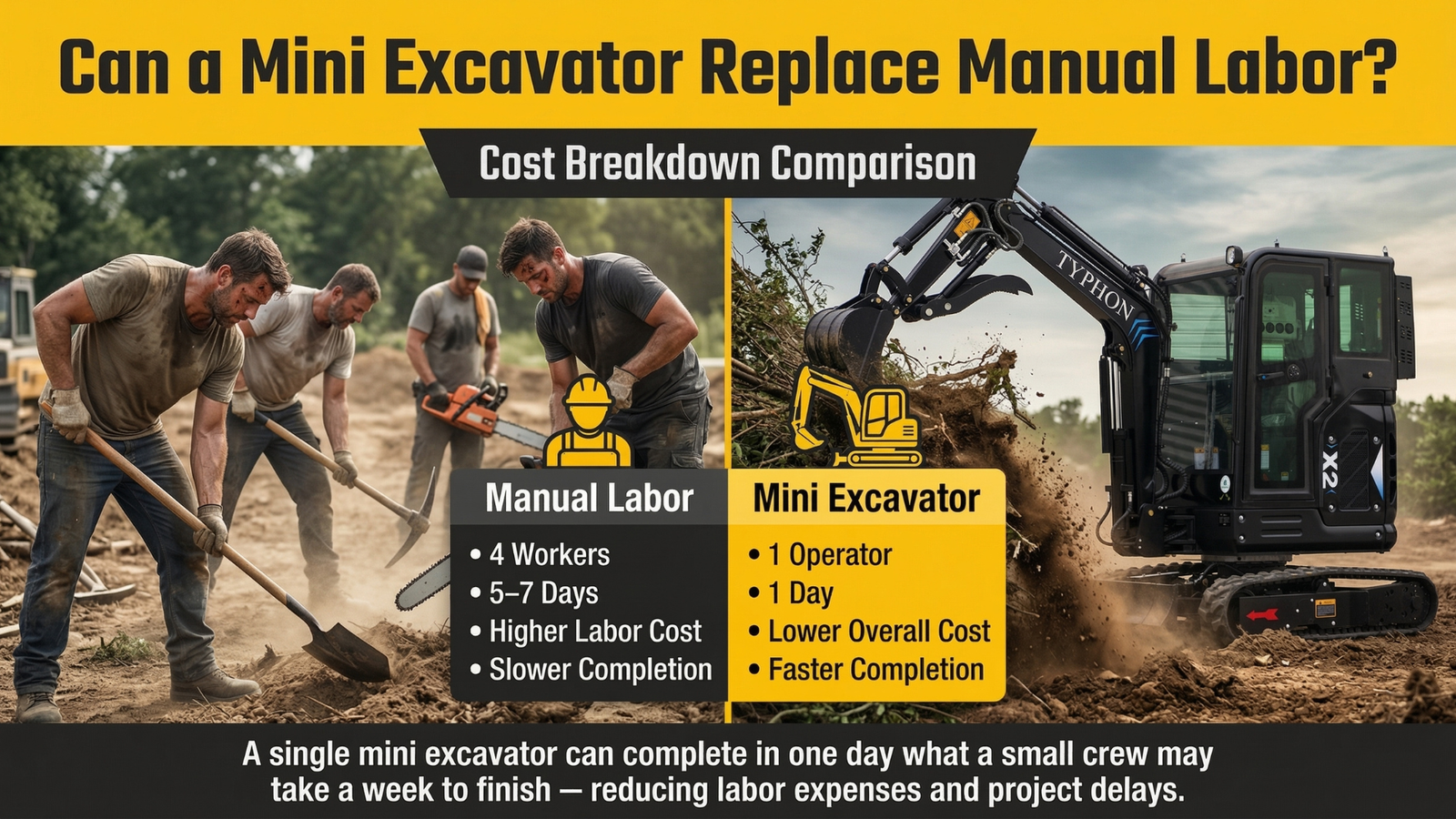
Can a Mini Excavator Replace Manual Labor? Cost Breakdown
In the construction and landscaping industries, the debate between manual labor and mechanical power is ongoing. For decades, the image of a crew of strong workers with shovels and pickaxes was the standard for small to medium-sized projects. However, as labor costs rise and the availability of skilled workers shrinks, business owners are forced to reevaluate their operational models. The question isn’t just whether a machine can do the work—it’s whether it can do it cheaper, faster, and better.
Replacing a team of laborers with a single mini excavator is a significant shift in strategy. It moves a business from a labor-intensive model to a capital-intensive one. But when you drill down into the numbers, the argument for mechanization becomes compelling. It’s not just about digging holes; it’s about redefining productivity and protecting your bottom line.
This breakdown explores the financial and operational realities of swapping sweat equity for hydraulic power. We will compare the output of a manual crew against a single operator in a mini excavator, analyzing the costs, time savings, and long-term impacts on your business growth.
The Economics of Labor vs. Machinery
To understand the true cost difference, we have to look beyond the hourly wage. A common mistake is comparing the hourly cost of a rental machine to the hourly wage of a single worker. This is an apples-to-oranges comparison that misses the scale of the work being performed.
Let’s consider a standard trenching job: digging a trench 100 feet long, 2 feet deep, and 1 foot wide in typical soil conditions.
The Manual Crew Scenario
To complete this task in a reasonable timeframe, you might deploy a crew of five laborers. Even if you pay a modest wage, the true cost of each employee includes payroll taxes, workers’ compensation insurance, and benefits. If the “burdened” labor cost is $25 per hour per worker, a five-person crew costs you $125 per hour.
Physically digging a trench is grueling work. As the day progresses, fatigue sets in. What a crew can accomplish in the first hour of the shift is significantly more than what they can do in the eighth hour. On a hot summer day, productivity drops even further as frequent breaks become necessary for safety. If this crew takes eight hours to dig that 100-foot trench, your direct labor cost for the day is $1,000. This doesn’t account for the potential costs of back injuries or heat exhaustion, which are real risks in manual excavation.
The Mini Excavator Scenario
Now, imagine replacing that entire crew with just one skilled operator and a 3,500-lb mini excavator. Because the operator is a pro, they earn a higher wage—let’s say $45 an hour. You also have to pay for the machine’s fuel, maintenance, and the normal wear and tear that happens over time. Let’s call the machine cost $35 an hour. That brings your total cost to roughly $80 an hour.
Here is where the numbers look totally different. A mini excavator doesn’t get tired. It digs just as hard at 4:00 PM as it did at 8:00 AM. That same 100-foot trench that took a whole crew all day might take a skilled operator only two or three hours.
At $80 an hour for three hours of work, your total cost is just $240. Compare that to $1,000 for manual labor. Even when you include the cost of moving the machine to the job site, you’re still saving a massive amount of money.
Speed and Project Turnover
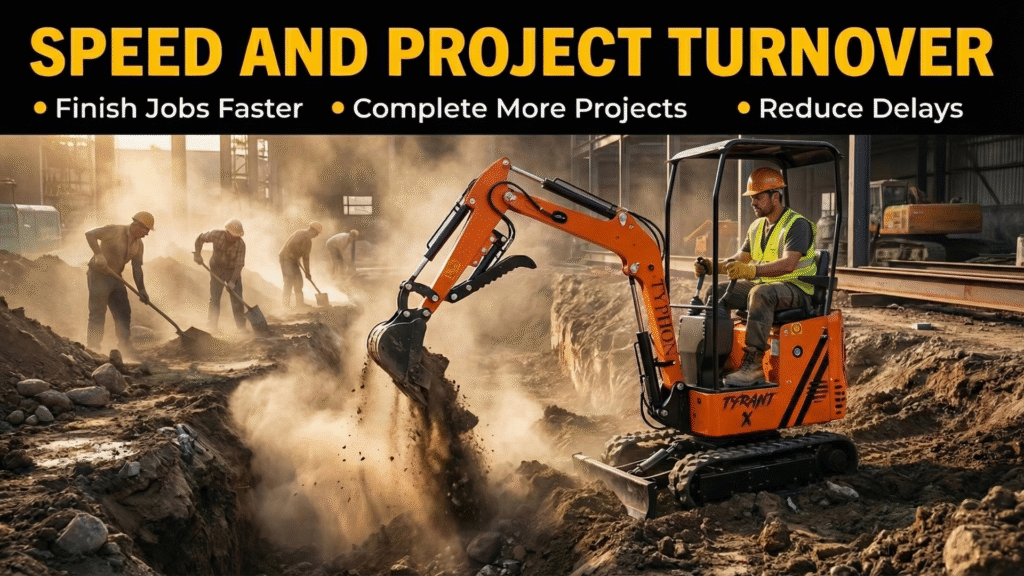
Time is the most valuable currency in construction. The faster you complete a job, the sooner you can move on to the next one, and the more revenue you can generate in a season.
In our example, the manual crew tied up your resources for a full day. The mini excavator finished the job before lunch. This efficiency creates a cascading effect on your schedule. With a mini excavator, you could potentially complete two or three similar trenching jobs in the time it took the manual crew to finish one.
This speed also protects you from project creep. Manual labor is highly susceptible to external factors. A sudden rainstorm can halt a digging crew instantly, turning a muddy trench into a multi-day ordeal. A mini excavator can often work through light rain or manage muddy conditions that would bog down human workers. By reducing the time a trench is open, you also reduce safety liabilities and the impact on the client’s property.
Reliability and Consistency
Humans are variable; machines are consistent. Relying heavily on manual labor exposes your business to the unpredictability of the workforce. If two members of your five-person crew call in sick, your productivity for the day is cut by 40%. The trench doesn’t get finished, the schedule slips, and the client gets frustrated.
A mini excavator is ready to work whenever you are. As long as you have one operator, your digging capability remains at 100%. This reliability allows you to bid on projects with confidence, knowing exactly what your production rates will be. You aren’t crossing your fingers hoping the crew shows up; you are planning based on the known capacity of your equipment.
Furthermore, the quality of the work is often superior with a machine. A bucket cuts a clean, consistent line at a uniform depth. Manual digging often results in uneven trench bottoms and irregular widths, which can lead to issues when laying pipe or pouring concrete. Correcting these manual errors takes even more time and money.
The Versatility Factor
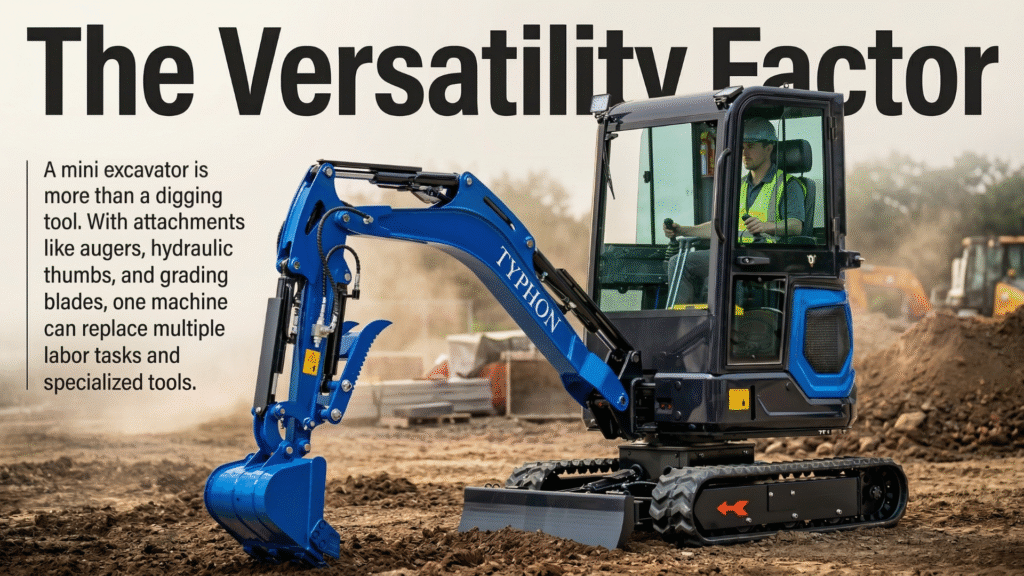
When you hire a laborer to dig, they can dig. When you hire a mini excavator, you are hiring a multi-tool system. The comparison extends beyond simple digging because the machine can switch tasks instantly.
Once the trench is dug, the same machine can backfill it in minutes using a blade or bucket. A manual crew would need to shovel that dirt back in, a process almost as exhausting as digging it out. If you encounter a large rock or a tree stump, the manual crew might be stalled for hours trying to remove it with pry bars. The excavator pops it out in seconds.
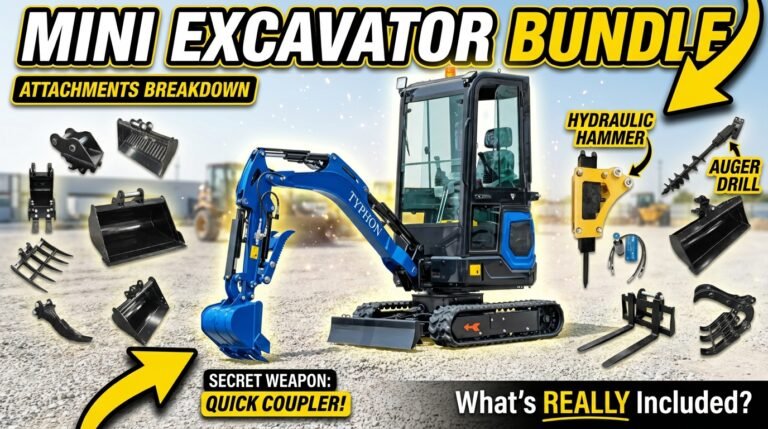
With attachments, the mini excavator replaces even more specialized labor. An auger attachment replaces the two-man team needed for a gas-powered post hole digger. A hydraulic thumb allows the operator to pick up and place heavy landscaping rocks that would require four men to move safely. This versatility means you need fewer specialized subcontractors and can keep more profit in-house.
Conclusion
The question “Can a mini excavator replace manual labor?” has a clear answer: Yes, and it usually does so with a significant return on investment. While the upfront cost of purchasing or renting a machine can be intimidating compared to the “pay-as-you-go” nature of hourly wages, the efficiency gains are undeniable.
Replacing a five-person crew with one operator doesn’t just save money on a spreadsheet. It reduces your administrative burden, lowers your insurance risk, and drastically increases the speed at which you can deliver projects. In a competitive market where margins are tight and clients expect rapid results, clinging to manual methods for heavy excavation is a difficult business model to sustain.
Investing in a mini excavator is investing in the scalability of your company. It allows you to do more work with fewer headaches, turning the unpredictable chaos of a job site into a controlled, efficient, and profitable operation.