Free Shipping Within USA | 1-year Warranty

Mini Digger: The Ultimate Guide for Buyers, Owners & DIY Enthusiasts
Essential machines like mini diggers have become the favorites of the above-mentioned groups of people and a their alike. To name a few, a mini digger is a perfect tool in a situation where you wish to refurbish your backyard, lay the utility trenches, or make small construction jobs. Once you hire a mini digger, the job which was physically overwhelming becomes easy, fast, and time-saving.
Along with that they have a great feature, which is a perfect fusion of their compact size, power, and versatility, thus making them suitable for both tight spaces and heavy-duty excavation tasks. Unlike large excavators that require a wide area and a professional operator, mini diggers are easy to learn, cost less, and can do quite a surprising amount of different jobs.
The mini digger is the type of the machine that is endowed with outstanding maneuverability and is probably the main reason why the majority of people choose mini diggers.
If you ever tried to dig with a shovel in your garden which is located in a narrow corner of your house or between the structures, then you sure know how frustrated it can be.
Mini diggers are “free” machines as they go into areas where a full-sized excavator cannot, but at the same time, they supply enough power to split hard ground, cut roots, dig foundations, and lift heavy materials.
This outstanding adaptability has led the use of mini diggers as a dominant machine in the hands of small business owners, DIY enthusiasts, and even people who have never thought of operating heavy equipment before.
This guide aims to teach you the ins and outs of using a mini digger and also various types, purchase tips, safety, maintenance, expenses, and much more.
The writing style of each chapter is designed to offer you practical knowledge and give you a wide choice of real-life situations, so after the reading, you’ll be able to make decisions wisely when buying a mini digger, safely use it, and stretch your investment to the fullest.
If you are unfamiliar with machines and construction, and already have experience, this guide will be your most valuable resource for everything related to mini diggers.
Understanding Mini Diggers
What Is a Mini Digger?
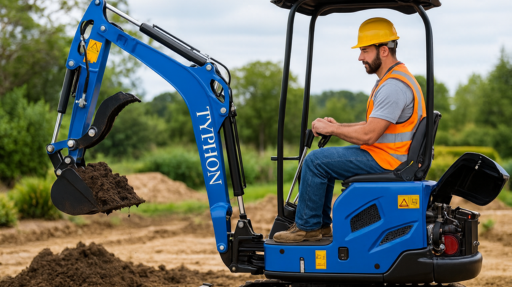
A mini digger or mini excavator is basically a compact version of the traditional excavator but is mainly made for smaller work, that requires more precision. Mini diggers operate where full-size excavators cannot be used due to either the area being too narrow, there being too little space, or the ground not being able to support heavy machines.
The lightest among them can weigh as low as 0.8 tons and the heaviest can be up to 6 tons, which makes them not very heavy for the normal vehicle trailer yet powerful enough to dig deep, lift materials, and perform a great number of different tasks. Their size between weight and power is the reason for their immense versatility and popularity in residential, agricultural, and small-to-medium-scale construction projects.
A mini digger is one of the most labor-efficient machines, hence the most obvious is that labor that would take a human hours or days to complete can be done in a very short time. For example, digging a trench for drainage or utilities by hand is exhausting and time-consuming, and the ditch will also be uneven.
The same task can be accomplished by a mini digger but precision will also be higher and it will take only minutes of the time. The small body permits the operator to go through garden gates, narrow alleyways, and cramped workspaces thus not damaging the structures and also not requiring a lot of clearance.
Hence, they are perfect for renovations of backyards, installation of fences, landscaping, small foundations, tree removal, and the minor demolition works.
What makes mini diggers the most special, they can also be used in various other ways apart from just excavating. You can choose which bucket or breaker to slot in among the auger, grapple, and various other accessories and then the mini digger can do the new task (cutting, drilling, grabbing) you assigned it.
Thus, landscapers can use mini diggers to grade soil, shape terrain, move rocks; farmers for ditch cleaning and fence post installation; contractors for foundation work, utility trenching. The fact that they are very easy to operate means that even a total beginner can learn how to handle them safely in a very short time.
Mini diggers are not only a must-have for professionals but also for DIYers who wish to cut down on the cost of excavation by doing it themselves.
How Mini Diggers Work
Mini excavators function through the use of hydraulic power, mechanical controls, and tracks for movement to carry out operations such as digging and lifting with accuracy. The hydraulic system is the core of the device, and it is the very thing that provides the mini digger with great power in spite of its small dimensions.
When the driver changes the position of the joystick in the cabin, hydraulic fluid is sent through hoses to cylinders. These cylinders extend or retract, causing the boom, dipper arm, or bucket to move.
The use of this fluid-powered force enables the excavator to go through hard soil, to lift heavy things, and at the same time, to keep the movements even and stable on the ground which may be rugged. Mini diggers without the help of hydraulics would not have the muscles required for heavy-duty earthworks.
The part of the machine, which normally consists of rubber or metal tracks, is very instrumental in the movement of the mini digger. The tracked system allows the machine to distribute its weight in a balanced manner, thus it is stable even on soft earth or steep places. This is beneficial especially if the work is to be performed in muddy places, wet grass, or on a gravel surface, where wheeled machines would either get stuck or sink.
Tracks also enable the mini digger to turn around its center point, thus giving it great maneuverability. Because it can rotate 360 degrees the operator is therefore free from the work of repositioning the machine all the time, hence a lot of time is saved and destruction of the ground is avoided.
In the cabin, contemporary mini diggers have very easy-to-understand controls that facilitate the work. Generally, there are two joysticks in the machines – one is for the operation of the boom and the bucket and the other for the swiveling of the arm or the turning of the cab. Pedals and additional levers may be used for the movement of the tracks.
Besides, new models have intelligent functions like automatic idle, digital displays, and air-conditioned cabs that make workers comfortable even during long hours. Whatever kind of work – trench digging, soil leveling, or concrete breaking, the operator will always feel that the machine is under their command because of the control system being used.
Mini diggers with their advanced hydraulics, strong tracks, and simple-to-use controls, are able to provide both power and accuracy, which make them a necessity, not only in professional worksites, but also in domestic projects. Their effectiveness and ease of use are the main factors behind their increasing popularity all over the world.
Key Components of a Mini Digger
From the point of view of the outside, a mini digger could be considered a simplistic piece of machinery, but once you dissect it, you will find it has several major parts that are essential for delivering the qualities of power, precision, and efficiency to the machine.
Knowing these parts not only enables you to work with the machine, but it also assists you in figuring out where the problem is, selecting the right model, and taking care of your digger properly over time. We will now explore those core systems that turn a mini digger into a powerhouse.
The undercarriage is the most fundamental part of the mini digger. The base that is fitted with rubber or steel tracks is what provides the mini digger with stability and power. Rubber tracks are most suitable for house projects as they lessen the destruction of the ground, thus, are great for gardens and driveways.
Steel tracks, contrarily, are made for heavy-duty work areas like construction zones, rough ground, or the areas where the buildings have been demolished. In addition to that, the undercarriage is where travel motors are located, the motors that determine how smoothly and accurately the machine can be moved over different surfaces. Besides balance, grip, and long life, a serviceable undercarriage can give you these three at the same time.
The hydraulic system is the machine’s main source of power. It carries out almost every machine movement — such as the lifting of a boom and the curling of a bucket.
It is the hydraulic pump that pushes the high-pressure fluid into hoses and then to the cylinders, and this is what produces the power that is used for digging into hard-packed soil or lifting of heavy stuff. The machine can thus also be used for turning the cab, operating extra attachments, and the machine being kept responsive.
Hydraulics, for example, checking fluid levels, and replacing filters are some of the things that are very important for smooth operation and breakdown avoidance.
One more significant component is the boom, the dipper arm, and the bucket assembly. The boom is the main one, out of the three, the curved arm that is fastened to the digger’s body. The dipper arm is attached to that, which simply means, it is the one that can be extended and the bucket is the one that is fixed at the end.
Buckets are made depending on the size of the work that has to be done. As an illustration, trenching buckets are made extremely narrow for precision digging, whereas grading buckets are made to be wide for flattening and shaping soil. The parts combined together with a mini digger make it able to move and dig in the ways most typical for that machine.
Moreover, the operator’s cab is the place where everything is united. Cabs of today have among other things, ergonomically designed seating, joystick for easy control, and climate control. In general, a comfortable operator is an efficient operator, especially during the long work hours. Altogether, these parts form a unit that is not only powerful, but also dependable and, quite, capable of being used in many different ways.
Types of Mini Diggers
Mini diggers are available in various types, with each type being suitable for different kinds of surroundings, different amounts of work, and different projects. Knowing the categories will help you select the right machine for your requirements, whether you are a home user doing a backyard project or a contractor managing several job sites. All mini diggers structurally are the same; however, their differences in size, features, and capabilities can have a substantial effect on the output and can also improve the work.
Micro diggers are probably one of the most typical types to be mentioned. It is a very small but still a very strong machine that usually weighs less than one ton. Such machines are perfect for absolutely smallest places – garden gates, narrow paths, or indoor renovation work could be examples.
Though these are of the smallest size, they offer the most extensive digging depths and are very flexible. A great deal of landscapers and DIY enthusiasts prefer micro diggers as they are easy to load on small trailers and are friendly in terms of works done in places where no big machine can fit.
Besides, plumbers and electricians who have to dig trenches in restricted areas without blasting the whole landscape are amongst the users of micro diggers as well.
Following are the standard mini diggers that typically weigh from 1.5 to 3.5 tons. These machines are the most popular and commonly used type, and they are the best compromise in between two extremes – one being a machine of great power and the other a machine of compactness.
These devices can undertake a wide range of jobs such as digging foundations and trenches, clearing land, and cutting tree roots. Due to their versatility, they have become the favorite weapon of small construction firms, farmers, and professional landscapers. They also provide less depth than medium-sized projects can dig and can help lift weights better than micro diggers.
The electric mini digger is another category gaining popularity. Such earth-friendly machines get their energy from batteries which, unlike diesel, cause no pollution and make the work considerably quieter.
They are safe for indoor work, noise-restricted urban environments, or projects where environmental sustainability comes first. To-date, their power is somewhat less than that of the diesel model, but the development is going at a very fast pace, and by now, electric mini diggers are already considered a viable alternative by many professionals.
Finally, there are zero tail swing mini diggers that have been specifically designed for cramped city surroundings. Such machines are created in a way that the rear part of the digger does not go beyond the tracks when turning, thus allowing the operator to move safely near the walls, fences, or other structures. These give more stability and safety to the user and are the perfect solution for small areas where accuracy is a must.
Micro Diggers
Micro diggers are the smallest and most nimble machines of the excavator series, generally their weight is between 0.8-1.2 tons. These machines are tremendously effective and can handle difficult tasks in very tightly confined spaces, although their small size is not meant to discourage you.
Micro diggers can do places where standard mini diggers can’t simply by the fact they can’t go. Think of a alley behind the house, a tiny corner of the backyard, or even a teardown project inside the house. Micro diggers can go through openings as narrow as 70–80 cm, thus they are the perfect tool for restricted-access projects.
One of the greatest features of micro diggers is their light structure which contributes less pressure being put on the ground, thus the ground is less likely to be damaged.
In case you work on a lawn that has been landscaped, a patio area, or a driveway that has been freshly paved, these small machines cause less ground disturbance than big ones. You can also move them with ease — a compact trailer can be used to carry most micro diggers or even a van will do if it has the proper set up.
Hence, they are extremely handy for workers who have to make quick job-site changes, and homeowners who decide to rent a machine for a one-day project.
As far as their abilities are concerned, a micro digger can go down to a considerable depth of a pipe or a trench with a maximum 2 meters measurement, in fact they can easily perform tasks related to soil, garden rehabilitation, pipe laying, and stump removal.
You will find that some of the micro digging machines are designed with detachable tracks that broaden for stability during digging and snuggle for narrow access, thus you benefit from the both worlds – compactness and steadiness. The very much adjustable blade goes further on work such as grader and backfill thus increasing the machine’s versatility.
To list some of these attachments: narrow trenching buckets, grading buckets, augers, and even small demolition task breakers can be supported by micro diggers.
This attachment changing capability makes it possible for the micro digger to be on the top of the list in the heavy machinery category used by electricians, plumbers, landscapers, and DIY homeowners for whom it is an all-in-one machine that can carry out the task without much support from the workforce.
Would you need to create a drainage trench in your backyard, get the garden ready for landscaping, or do some work inside a building where silence and space are matters of concern, then a micro digger is the right choice for you as it is a strong, small-sized, and time-saving tool. This must be the very type of the machine that demonstrates the argument whether big things really do come in small packages.
Standard Mini Digger
Standard mini diggers are generally 1.5 to 3.5 tons and are the most popular machines of the compact excavator category. They have an ideal balance of size, strength, and versatility which makes them suitable for residential as well as commercial projects. These machines have the strength to be able to do the heavy work but are still small enough to fit into places which a full-sized excavator cannot.
Hence, standard mini diggers are the device of choice for contractors, builders, landscapers, farmers, and even for DIY enthusiasts who are serious.
Standard mini diggers have the main advantage of their greater digging depth and lifting capacity. Micro diggers are excellent for very limited spaces, however, they might be limited in the case of heavier or deeper works.
Whereas standard mini diggers are capable of digging 3–4 meters depending on the model, they are perfect for digging foundations, large landscaping projects, installing septic tanks, and trenching for utilities. Their hydraulic systems are more powerful, thus they can perform better when working with hard soil, rocks, or heavy attachments like breakers and augers.
Electric Mini Diggers
In a very short period of time electric mini diggers have become one of the most innovative and highly sought machines in the area of compact excavators.
With industries progressively leaning towards greener, quieter, and more efficient solutions, electric mini diggers seem to be the winners in the contractors, homeowners, and businesses’ circle who want to cut emissions without performance compromise.
These devices use rechargeable batteries of high capacity rather than diesel engines, thus they are environment-friendly, silent, and suitable for places where the use of traditional machines is not feasible.
What most likely is one of the factors that customers are drawn to electric mini diggers is their almost silent operation. In contrast to models powered by diesel which can be noisy and disturbing, electric units emit very low noise, and therefore, they are capable of operating in noise-restricted areas like residential neighborhoods, hospitals, schools, and urban zones.
Consequently, such a low noise level allows them to be used at an early hour or late at night, a time that most likely noise complaints will be submitted and the project will have to be suspended. There are also great benefits for indoor projects, too — since electric mini diggers produce no exhaust fumes, they can be operated safely in any indoor environment such as buildings, basements, factories, and warehouses.
Zero Tail Swing Mini Excavators
If your work environment consists of cramped, limited, or cluttered with obstacles spaces, then zero tail swing mini diggers are a perfect solution to you. Normal mini diggers have a rear counterweight that extends out beyond the tracks when the cab is rotated.
Thus, working near walls, fences, buildings, or other machines can be dangerous as the back of the digger can easily hit the surrounding structures. Zero tail swing versions remove this problem entirely as they keep the rear of the unit within the width of the tracks even when a full 360-degree rotation is made.
The invention tremendously enhances both safety and the operator’s mood. Zero tail swing devices lessen the chances of a collision with a wall when you are working in a narrow alleyway, next to a house, inside a partially constructed building, or in an urban environment with pedestrian traffic and cars nearby.
For contractors, it is not only about the ease of work – the prevention of costly property damages, project postponements, and insurance problems is the real advantage. The modern zero tail swing models have been made more stable and thus their movements are smooth, accurate even when close to edges or in tight corners.
Engine Power & Performance
When figuring out the right mini digger for you, it makes sense to look at the engine power and the overall performance first. These are the main factors that influence how the machine can deal with tough soil, heavy attachments, and hard-to-handle job-site conditions without wasting power.
Actually, it is the engine that acts as a mini digger’s heart, it is the source of power for everything from hydraulic functions to track movement. Lower horsepower can be good enough for a small DIY project, but a more powerful engine will be mandatory if you want to do excavation or construction at a professional level.
The majority of mini excavators are equipped with diesel engines of various sizes – from 10 HP to 65 HP – depending on the model and its dimensions. Take micro diggers as an instance, their engine power usually varies between 10 and 20 HP, carter to shallow digging or small-scale landscaping.
Whereas regular mini diggers are often powered by engines with a capacity of 20 to 40 HP, thus they have the ability for deeper digging, higher lifting capacities, and can be used heavier-duty attachments like breakers and augers more smoothly.
Simply put, the mini digger with more horsepower is capable of pushing through dense clay, compacted earth, gravel, and rocky soil without putting too much strain on the engine.
Operating Weight
Operating weight is definitely one of the key features that you need to know when deciding on a mini digger but is also one of the most forgotten features. This is the total weight of a machine with the tank filled with the fuel and hydraulic oil, plus the weight of the operator and the standard bucket.
So, why is this important? Because the operating weight is the main factor that determines stability, digging depth, transportability, lifting power, and even the type of terrain your machine can handle. The operating weight is the factor that can be the reason for your project’s success or failure in case of buying or renting a machine.
As a matter of fact, the operating weight of a micro excavator is generally less than one ton, thus making it a perfect tool for surface work that requires a high degree of care such as garden lawns, tiled patios, paved walkways, indoor floors, etc. Accessing the tight spaces becomes a non-issue with them as their lightweight construction doesn’t allow the ground to be overly damaged.
On the other hand, this lighter weight also leads them to have restrictions with regard to the maximum load and the digging power. While they are great for small, shallow projects, they might have trouble going deep trenching or heavy lifting.
Bucket Capacity & Attachments
Bucket capacity and attachments are the two elements that can influence the most by how much a mini digger is versatile, productive, and efficient. Although the engine is the source of power and the hydraulics are the carriers of strength, in the end, it is the bucket and attachments that determine the range of the machine.
The correct application of parts can convert a simple mini digger into a multifunctional tool able to work in numerous areas — be it digging and grading or demolition, lifting, drilling, and even landscaping artistry.
A bucket volume is the amount of material a bucket can hold in one go, and it is normally expressed in liters or cubic feet. Very small buckets (8–12 inches wide) are specially designed for trenching in narrow areas, for instance, laying irrigation pipes, electrical cables, or drainage systems.
Using such buckets, digging can be done very accurately without damaging the rest of the soil. Medium buckets (18–24 inches) are the most frequently chosen ones and provide a great mix between precision and volume. They are perfect for general excavation, landscaping, and foundation digging. Big grading or ditching buckets (36–48 inches) are intended for land shaping, leveling ground, ditch cleaning, and taking off loose soil rapidly.
The true power of a mini digger lies in its attachments, not just in the bucket. Modern compact excavators have the capacity to hold various specialized tools that can extend their functions far apart from just one:
- Augers – Are employed for drilling holes for fence posts, trees, decking supports, and signposts. They come in several diameters depending on the type of the soil and the depth requirements.
- Hydraulic breakers – Make your mini digger a jackhammer. It’s efficient in breaking pieces of concrete, rock, old driveways, or foundations that are hard of access and are made of solid materials.
- Grapples – Great for picking up logs, debris, rocks, or demolition material quickly and accurately.
- Rippers – Are great for the hard ground, frozen soil, and rocky terrain that can hardly be brushed away with a standard bucket. They tear up such surfaces with ease.
- Tilt buckets – Provide the means for significantly advanced forming, sloping, and grading work with better control and precision.
The proper selection of attachments is a factor that not only leads to work done at twice the speed but also to the quality of the output being double as well. By way of example, using a grading bucket for leveling soil results in a much smoother finish than if you were to do it with a trenching bucket.
The same goes for the planting of trees; if you use an auger, you will get perfect, identical holes within a fraction of the time needed for manual work, something almost unattainable by hand.
Besides that, the use of attachments prolongs the life of the money invested in the purchase. A mini digger with three to five top-notch attachments can do the work of numerous standalone tools and, if you are a contractor, your earning potential will rise by a great margin. Even for the owners, the decision to either hire or purchase the correct attachment can make their weekend project a walk in the park.
How to Choose the Right Mini Digger
Assessing Project Requirements
A right mini digger to be able to choose, every detail of a project must be carefully examined. Most of the time, a machine is selected on the basis of its price or size only, and thus, we are left with a mini digger that is out of work halfway through because it lacks the required depth, the power for lifting or the mobility.
The rental or purchase decision will be made quicker, cheaper, and less frustrating if you ascertain first what kind of work you have to do. And in addition, you will be sure of the machine’s performance.
Size and scale of a project would be the first consideration for a person. Is it a garden-trenching task or a building-two-storeyed-basement one? In any case, the tiny digging-machine would do for many of the projects like garden landscaping, trenching for irrigation, pond making in the garden, and post installation for fencing.
These models, which can weigh between 1 to 1.5 tons, are transportable, less damaging to the surface, and able to fit in the small and awkward places. Besides, the conditions are very different to demand an extra heavy mini digger or one in the 3 to 3.5 ton range with the better hydraulic and deep digging functions for foundation digging, tree-stump removing, terrain shaping, and concrete breaking.
Site accessibility shall be evaluated next. There are mini diggers of different sizes in the market, and the width among them may vary considerably as small ones can be as slim as 70-80 cm, while other models are far wider.
If you can’t get the machine to the workplace because it is at the back of the house or in a yard where there are fences around, then you’ll better forget about the job altogether.
It may be worthwhile to review the width of the gates, check for any slopes, consider the character of the ground, and see if there are any trees, patios, or even roads near the place. Maybe you will also find that very quiet and non-polluting electric mini diggers fit better for a work done in a high-density area or inside a building.
Another key point to think about is soil and terrain. Clay, rock-covered soil, frozen and root-packed wood all require a medium or heavy machine with a strong hydraulic breakout force to get the job done. Or else, the job will be done slowly, and perhaps only partially, by some light micro excavators. However, one may ask such a question: can soft soil, sand, and presence of lawn cause any damage to the surface? I would answer it by saying that such places are best for lightweight machines with a low ground pressure.
Besides, it is necessary to determine the required attachments. Should the project be of a nature that seeks drilling post holes, concrete breaking, or heavy debris lifting, the first thing that should be ensured is the machine’s compatibility with the hydraulic flow and auxiliary connection of the tool-used.
Not all mini diggers allow powerfully driven attachments; therefore, coupling the machine’s capability with correct and as planned tasks leads to a smoothly functioning operation.
Think about the experience you have as well, is one of the final deciding factors. The control system prowess, enhanced stability, or user-friendliness factor may become a characteristic of some machines, and hence, a beginner will handle them with much ease. For example, zero tail-swing models suit best operators who are not skillful working near structures as they do not allow the risk of hitting obstacles.
Weighing up these factors ensures that you pick out a mini digger which is right for your job, thereby overcoming the issues of time delays, overworked machines and budget overspending.
Conclusion
A mini digger is a must-have tool in your arsenal for any kind of project be it construction, landscaping, agriculture, or even a DIY project. The mini digger is the ideal tool that gives you just the right amount of power, control, and portability. Whether it is the utility trenching, the backyard transformation, the demolition, the land clearing, or the foundation preparations – the mini digger is the answer.
While its size small is the reason for its efficiency in the tightest of spaces, its hydraulic system is what makes it pretty strong and its extensive list of attachments is the reason it is suitable for almost any job. Therefore, a mini digger is somewhat of a genius, multi-functional, compact team worker compressed into one smart, compact machine.
Moreover, the biggest factor behind mini diggers’ popularity is their accessibility. Even novices can grasp the control mechanisms in no time because of the easy-to-use joysticks and modern cab designs. Contractors are glad to have them in their work due to their long-lasting and efficient nature.
Farmers are dependent on them for their regular chores, while homeowners use them for heavy work which is greatly simplified, one that used to take days of manual labor.
Besides that, several types exist, such as micro diggers, zero-tail swing, and even electric models- thus, the perfect machine for each environment and project size is at hand.
Picking the right mini digger involves knowing your requirements first: the soil type you will be working on, the depth of the dig which is required, the space which is available, whether or not you need any attachments, and what your budget is.
The machine that fits you will be the one that pays for itself by the hours you save in your work and the increase in your productivity whether you decide to buy new for long-term reliability or used for affordability.
The likes of JCB, CAT, Bobcat, Kubota, and Yanmar are great for your consideration when you’re looking for a good model. You can narrow down the best choice for your goals by performance, hydraulic power, comfort, and operating weight.
In the long run, having a mini digger means more than just owning a machine — it is a smart move towards greater efficiency. It can help to carry out bigger plans, complete tasks quicker, and get results of a high professional standard with much lesser work. Whether you intend to develop your property or start a business, a mini digger will become your reliable partner that keeps pace with your hard work.
FAQs
1. What size mini digger is best for home projects?
A mini digger of one to one and a half tons is generally sufficient for most residential work such as landscaping, trenching, and small digging jobs.
2. How deep can a mini digger dig?
The digging depth of mini diggers varies between 1.5 to 3.5 meters, depending on their size and model.
3. Can I operate a mini digger without experience?
Surely! Mini diggers are designed with beginners in mind. The majority of people can grasp the basic operation within an hour.
4. Are electric mini diggers worth it?
They are, if the work environment is noise-sensitive, indoors, or if you want to be eco-friendly (although you pay more initially).
5. How much does it cost to rent a mini digger?
The rental rates can be anywhere between $100 and $300 per day depending on the size, location, and attachments.