Free Shipping Within USA | 1-year Warranty
How to Choose the Right Road Roller Size for Small Projects
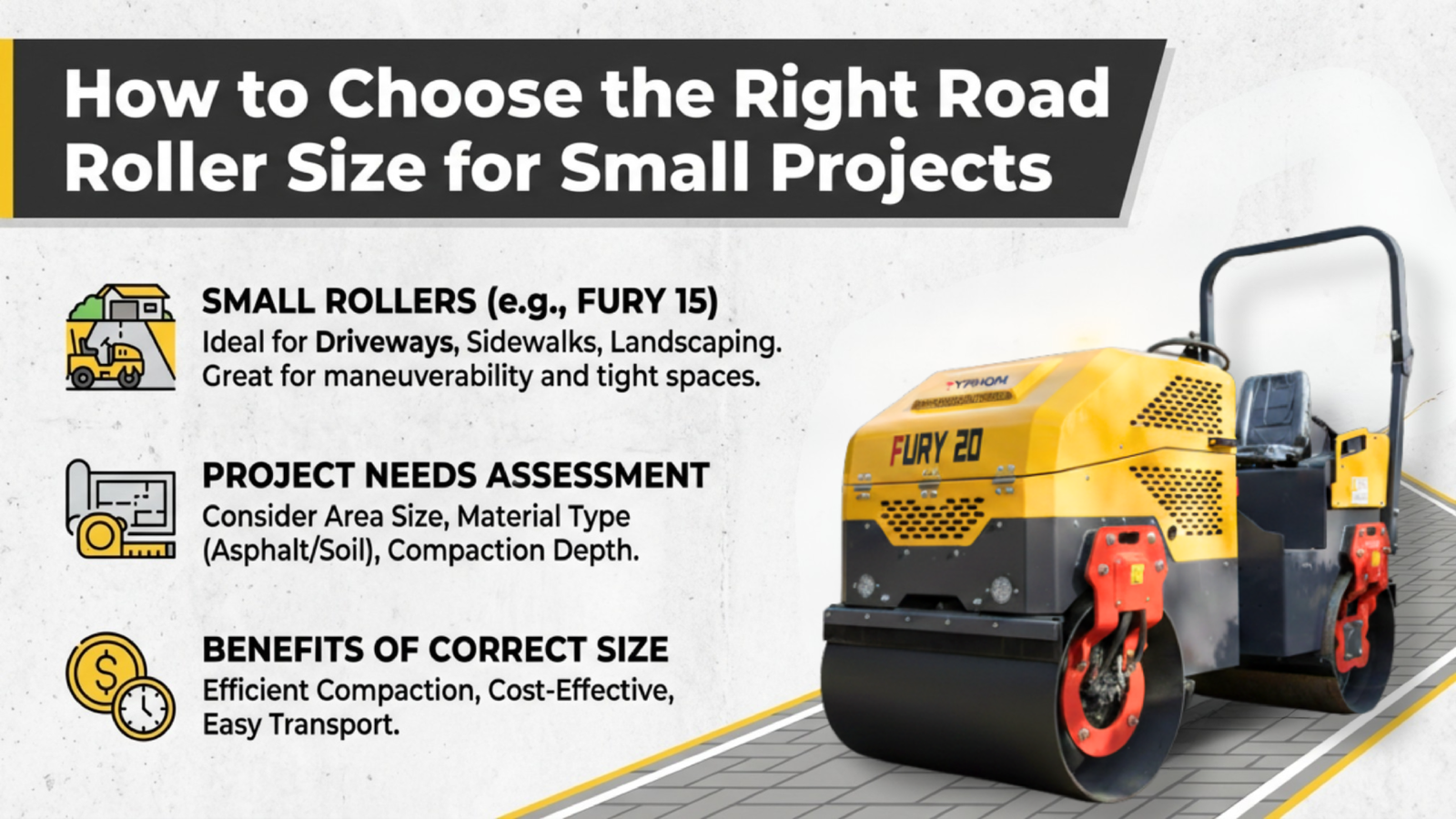
Compaction is often the most critical phase of any paving or earthworks project, yet it is frequently the most misunderstood. When tackling small projects—like driveways, bike paths, patch repairs, or landscaping foundations—the margin for error is surprisingly slim. Choosing a massive highway roller for a residential driveway isn’t just overkill; it can actually damage the surrounding infrastructure and result in poor compaction density due to maneuverability issues. Conversely, using a machine that is too small turns a three-hour job into a two-day ordeal, killing your profitability.
Selecting the right road roller involves balancing weight, drum width, and vibration frequency against the specific constraints of your job site. It requires understanding that “small” projects come with their own unique set of challenges, primarily involving space, surface delicacy, and transport logistics. Whether you are a contractor looking to expand your fleet or a project manager renting equipment for a one-off job, making the right choice ensures your surfaces stand the test of time.
Defining the Scope of “Small” Projects
Before you can select a machine, you must accurately define the parameters of the work. In the world of compaction, a “small” project usually refers to areas where maneuverability trumps raw tonnage. This includes residential driveways, parking lot patches, utility trenches, and walkways.
On these sites, the edges are often defined by rigid structures like garage doors, curbs, or retaining walls. A large tandem roller might cover the center of a driveway in two passes, but if it cannot get within six inches of the garage door without risking a collision, you are left with a significant amount of manual tamping. This manual work destroys your efficiency. Therefore, the first rule of sizing is to measure your tightest pinch point. Your roller needs to fit comfortably through the narrowest gate or pathway on the site while leaving room for the operator to steer safely.
The Role of Drum Width in Efficiency
Drum width is the primary factor that determines your job completion speed. A wider drum covers more ground per pass, theoretically finishing the job faster. However, on small projects, wider is not always better.
For a standard residential driveway or a small parking lot repair, a roller with a drum width between 35 and 47 inches is often the sweet spot. This size strikes a balance between coverage and precision. A 35-inch drum is narrow enough to navigate winding garden paths or compact utility trenches without bridging over the edges. It allows the operator to articulate around curves without the rear drum cutting the corner and crushing the landscaping.
If you step up to a 47-inch or 55-inch drum, you gain speed on straight runs, but you lose agility. On a small patch job, you might find yourself spending more time engaging in three-point turns to reposition the machine than actually compacting material. Match the drum width to the geometry of the job. If the project is long and linear, like a bike path, go wider. If it is square and confined, like a patio base, a narrower drum will actually be faster because it is easier to manipulate.
Weight and Static Linear Load
Weight is what actually achieves density, but how that weight is applied matters immensely. In technical terms, we look at “static linear load,” which is the weight of the machine divided by the width of the drum. This figure tells you how much pressure is being applied to the soil or asphalt before vibration is even turned on.
For small projects involving asphalt patching or thin driveway overlays, a roller in the 1.5 to 3-ton range is typically sufficient. These machines provide enough weight to knead the aggregate together without crushing it. If you use a machine that is too heavy on a thin layer of asphalt, you risk “shoving” the mat—pushing the material in front of the drum rather than compacting it downwards. This creates waves in the surface that are impossible to fix once the asphalt cools.
On the other hand, if you are compacting the sub-base (the gravel or soil foundation), you generally want the heaviest machine that the site can support. A 1-ton roller might struggle to achieve the required density on a thick layer of crushed stone, leading to settling and potholes later. If access allows, a 3-ton to 5-ton machine is preferable for base work to ensuring a rock-solid foundation.
Vibration Frequency and Amplitude
Modern road rollers don’t just roll; they vibrate. This vibration reduces the friction between soil or asphalt particles, allowing them to settle closer together. The settings you need depend heavily on what you are compacting.
For small asphalt projects, high frequency and low amplitude are your best friends. High frequency (rapid vibration) helps settle the surface stones to create a smooth, sealed finish, while low amplitude (a small physical movement of the drum) prevents the drum from bouncing and shattering the aggregate. Many small compact rollers are tuned specifically for this “finish” work.
If your small project involves compacting a soil trench or a gravel base, you need the opposite: lower frequency and higher amplitude. You need the drum to hit the ground harder to drive that energy deep into the lift of soil. Some small rollers offer dual settings, making them versatile for both base work and paving. If you are renting or buying a single machine for mixed use, look for this dual-frequency capability. It allows one small roller to perform the work of two specialized machines.
Transport and Site Logistics
A practical but often overlooked factor in choosing a roller size is how you plan to get it there. Small projects often have limited staging areas. You might not have space to park a semi-truck and a lowboy trailer to unload a 10-ton machine.
Rollers in the 1.5 to 3-ton class can usually be towed behind a heavy-duty pickup truck on a standard equipment trailer. This logistical flexibility is a massive advantage for small projects. It means you can mobilize quickly, get in, do the work, and get out without coordinating third-party haulers. If your roller is too big for your own transport setup, you are adding hundreds of dollars in delivery fees to a small job, which eats directly into your profit margin.
Types of Rollers for Small Spaces
Finally, consider the configuration of the roller itself.
Double Drum Rollers: These are the standard for asphalt. Both drums drive and both vibrate, giving you double the compaction effort per pass. They are excellent for flat, open areas.
Combination Rollers: These feature a steel drum in the front and pneumatic rubber tires in the back. They are fantastic for small projects because the rubber tires provide a kneading action that seals the surface tighter, making them ideal for driveways where water resistance is key.
Trench Rollers: For extremely confined spaces like utility ditches, a remote-controlled trench roller is often the only safe choice. These aggressive little machines apply massive force but keep the operator out of the excavation zone.
Conclusion
Choosing the right road roller for small projects is about precision, not power. It requires an honest assessment of your site conditions, your transport capabilities, and the specific material you are compacting. By prioritizing maneuverability and appropriate static load over sheer size, you ensure that even your smallest projects are built on a foundation of quality.
Don’t let the scale of the job fool you into thinking the equipment choice matters less. In many ways, small jobs require more finesse. The right roller allows you to achieve highway-grade compaction on a residential scale, leaving your clients with surfaces that look professional and last for years.