Free Shipping Within USA | 1-year Warranty
Rent vs Buy Construction Equipment: What Saves More Money?
As a construction business grows and takes on larger projects, it often faces an important decision about equipment. After winning a new contract, many contractors realize they need more machines to complete the job efficiently. This leads to a common question in the industry: Is it better to buy or rent heavy equipment? The choice can strongly affect cash flow and overall profitability.
Buying heavy equipment gives a company full ownership and long-term access to the machine, but it usually requires a large upfront investment. Renting, on the other hand, lowers the initial cost and offers flexibility for short-term jobs. However, rental fees can add up over time, especially if the equipment is needed for longer projects.
Before deciding, contractors should consider several factors, including how often the machine will be used, project timelines, maintenance responsibilities, and storage. If the equipment will be used regularly, buying may provide better long-term value. For occasional or short-term work, renting heavy equipment may be the more practical option.
This guide explores the key differences between renting vs buying heavy equipment, helping contractors understand the costs, benefits, and best situations for each choice.
The Financial Heavy Lifting: Upfront Costs and Capital
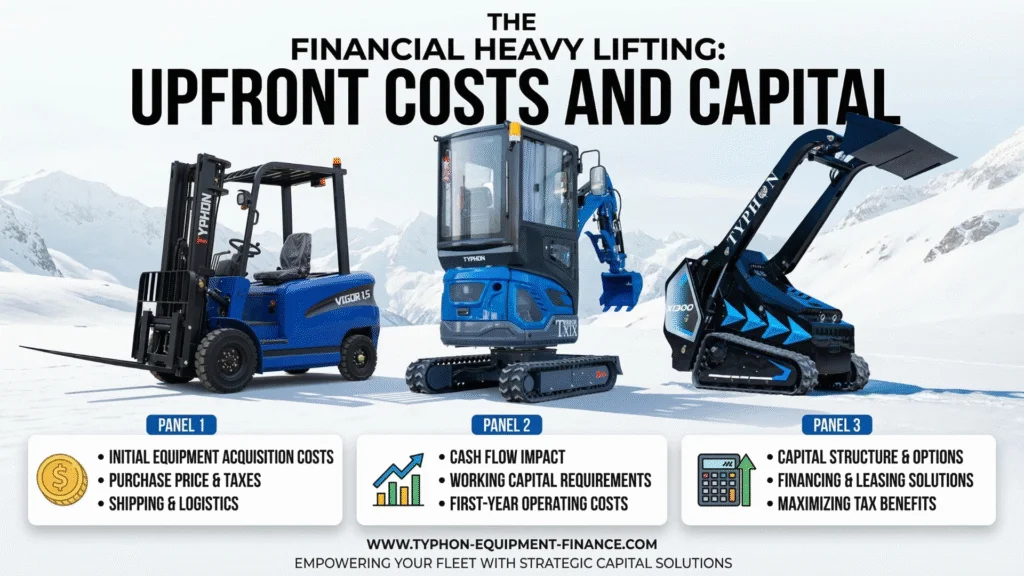
The most obvious difference between acquiring a new machine and renting one lies in the initial capital outlay. Heavy equipment represents a massive financial commitment that ripples through your entire balance sheet. Understanding how each option impacts your cash flow is the first step in making a sound business decision.
The Burden of Buying
Purchasing a brand-new excavator, bulldozer, or wheel loader requires significant upfront cash or substantial financing. Even with favorable loan terms, a down payment will instantly reduce your available liquid capital. This reduction in cash flow can limit your ability to handle unexpected project expenses, hire additional crew members, or bid on overlapping jobs. You must also factor in the cost of insurance, property taxes, and the immediate depreciation that occurs the moment the machine arrives at your job site.
However, purchasing does offer specific financial advantages for profitable companies. Tax incentives, such as the Section 179 deduction, allow businesses to deduct the full purchase price of qualifying equipment during the tax year it was bought. This can significantly offset the initial sting of a large purchase, making ownership a strategic tax move for established contractors looking to reinvest their profits.
The Flexibility of Renting
Renting preserves your working capital and protects your borrowing power. Instead of a massive down payment and a long-term loan on your books, you pay a predictable daily, weekly, or monthly rate. This expense is typically classified as a direct project cost, which makes job bidding more accurate and straightforward.
By keeping your cash reserves intact, you maintain the financial agility to navigate economic shifts or invest in other crucial areas of your business. If a project gets delayed due to weather or permit issues, or if a contract is abruptly canceled, you can simply return the rented machine and stop paying for it. This flexibility is a massive advantage in an industry known for unpredictable schedules.
Operational Realities: Maintenance, Storage, and Transport
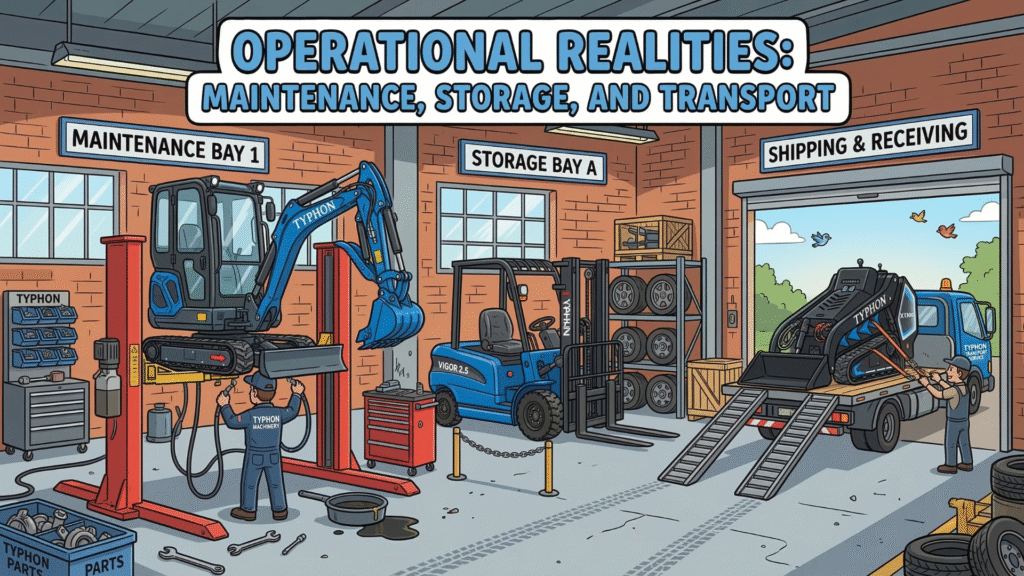
The sticker price is only the beginning of the equipment conversation. The hidden, ongoing costs of equipment management often dictate whether a purchase is truly profitable over the long haul.
Ownership Means Total Responsibility
When you buy a piece of construction equipment, you assume full responsibility for its entire lifecycle. This includes scheduling routine maintenance, paying for emergency repairs, and replacing expensive wear parts like tracks, bucket teeth, and hydraulic fluids. You need a reliable, highly trained mechanic, either on staff or on speed dial, which adds significantly to your operational overhead.
Furthermore, when the owned machine is not generating revenue on an active job site, you must pay to store it securely. Leaving expensive machinery exposed to the elements or in unsecured lots invites theft and accelerated wear. Transporting your own equipment between distant job sites also requires dedicated flatbed trailers, heavy-duty towing trucks, and commercial drivers, adding another layer of expense and logistical planning.
Renting Shifts the Burden
A rental agreement fundamentally changes your operational responsibilities. Reputable rental companies handle all routine maintenance, fluid changes, and servicing before the machine ever reaches your site. If a rented machine breaks down while you are working, the rental provider will typically dispatch a mobile mechanic or swap the equipment for a working unit immediately.
This level of support minimizes your downtime and keeps your crew highly productive. Storage and transport are also simplified dramatically. The rental company delivers the machine exactly when you need it and picks it up the moment you are finished, freeing you from managing complex logistics.
Project-Specific Needs and Equipment Utilization
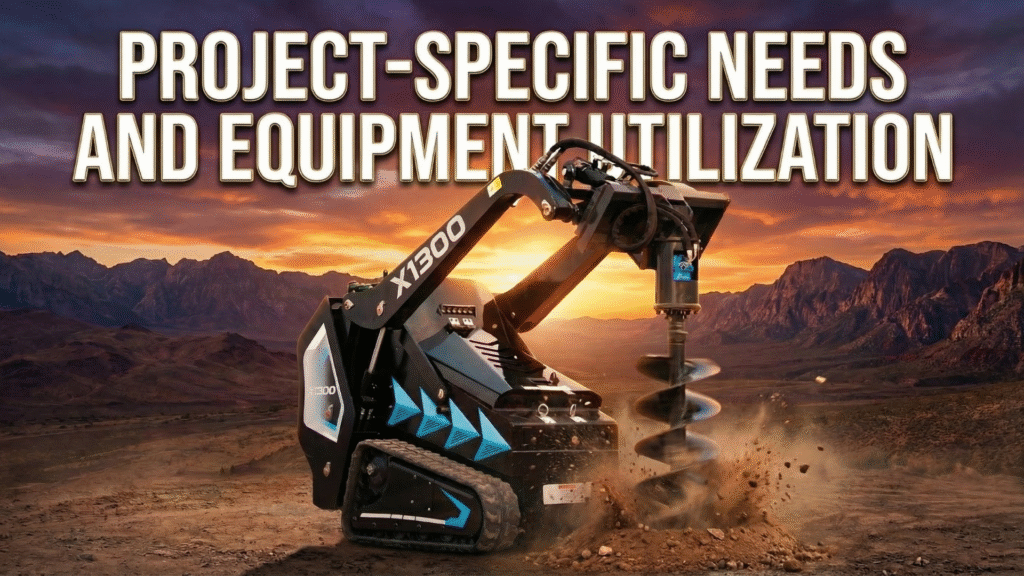
The smartest equipment decisions are driven by hard data, specifically your utilization rate. How often will this machine actually run, and what exact tasks will it perform?
The Rule of Utilization
Industry experts often point to the 60 to 70 percent rule. If you anticipate using a specific piece of equipment for more than 60 to 70 percent of your total working hours over the year, buying is usually the most cost-effective route. High utilization quickly offsets the initial purchase price, the interest on loans, and the ongoing maintenance costs. For a residential contractor who digs foundations every single day, owning a reliable mid-sized excavator is a fundamental necessity that builds equity over time.
Niche Projects and Specialized Gear
Conversely, if you need a machine for a specialized task or a short-term project, renting is always the clear winner. Suppose you secure a contract that requires an articulated dump truck for three weeks of heavy earthmoving, but your typical jobs only require standard skid steers. Buying that specialized truck makes absolutely no financial sense. Renting allows you to access the exact size and type of machinery required for a specific phase of a project without committing to a massive, long-term investment.
Technology, Depreciation, and Resale Value
Heavy equipment technology is advancing rapidly, impacting both job site productivity and long-term asset value. You must weigh the benefits of cutting-edge tech against the reality of depreciation.
Avoiding the Obsolescence Trap
Emissions regulations, fuel efficiency standards, and machine control technologies evolve every year. When you purchase equipment, you are locked into that specific era of technology. Renting, on the other hand, allows you to consistently upgrade.
Rental fleets are frequently updated with the latest models, meaning your operators get to use the most fuel-efficient, technologically advanced machinery available. Having access to modern GPS-grade control systems or ultra-efficient Tier 4 Final engines can lead to faster job completion and lower fuel costs. Renting allows you to leverage these advancements while completely avoiding the headache of equipment depreciation.
Building Long-Term Equity
Despite the reality of depreciation, owning equipment means building tangible equity for your business. A well-maintained machine from a reputable brand retains significant resale value. When it is time to upgrade or retire the asset, you can sell it on the private market or trade it in to offset the cost of new equipment. For established businesses with highly predictable workloads, this equity is a powerful financial tool. You transition from paying a rental company to building your own company’s net worth.
Real-World Scenarios: Making the Right Call
To bring these concepts to life, let us examine two common scenarios where contractors face the rent versus buy dilemma and must choose the path of maximum profitability.
Scenario One: The Growing Excavation Contractor
A mid-sized excavation company primarily focuses on installing residential utility lines. They currently rent a 5-ton mini excavator for roughly eight months out of the year to handle their workload. The monthly rental fees are heavily eating into their profit margins. Because their utilization rate for this specific machine size is exceptionally high, purchasing the equipment is the correct strategic move. The monthly loan payment will likely be lower than the cumulative rental fees, and they will build equity in an asset they use almost every day.
Scenario Two: The Commercial Builder with a Unique Job
A commercial building contractor usually constructs single-story retail spaces using standard telehandlers. They recently won a lucrative bid to build a four-story hotel, which requires a massive tower crane for a tight six-month window. Purchasing a tower crane would require millions of dollars, specialized storage yards, and highly trained maintenance staff. For this contractor, renting the crane is the only logical choice. It keeps their capital free, shifts the immense maintenance burden to the rental company, and ensures they have exactly what they need for a strictly limited timeframe.
Conclusion
Choosing whether to rent or buy construction equipment is not a guessing game. It requires a hard, honest look at your capital reserves, your maintenance capabilities, and your projected utilization rates. Buying makes sense when you have high utilization, strong cash flow, and the infrastructure to maintain the asset. Renting provides unparalleled flexibility, preserves your capital, and gives you access to the latest technology without the long-term commitment.
To make the most profitable decision, start by rigorously auditing your current fleet and tracking exactly how often you use each machine. If you find yourself repeatedly renting the same equipment month after month, it is likely time to transition to ownership. If you are taking on new, unfamiliar project types, lean on your trusted rental partners to scale safely. By aligning your equipment acquisition strategy with your actual business operations, you secure your profit margins and set your company up for sustainable, long-term success.